Already in Practice
 Share
Share
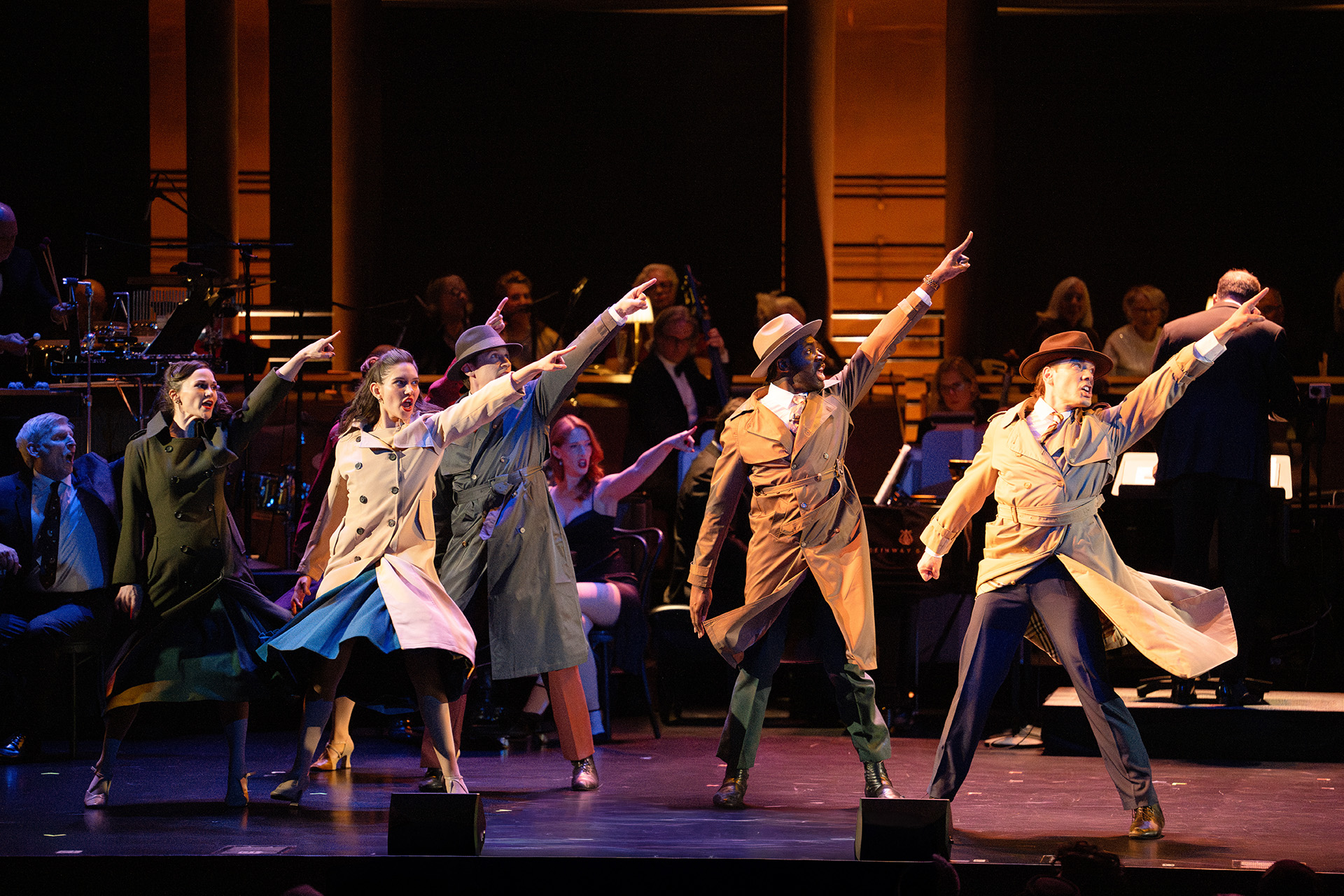
A performance of Sweet Smell of Success at Lincoln Center, choreographed by Andrew Palermo. Photo by Toby Tenenbaum.
At UCI Arts, curriculum and collaboration turn arts education into a professional pathway
By Diana Kalaji
How do you share the importance of an arts education without being defensive? It may sound rudimentary, but it's a question that faculty and arts leadership answer every day.
Often, when someone shares they are pursuing the arts, they are met with responses like “How are you going to make a living?” or “OK, but what are you really going to do?”
As a comprehensive arts school within a top-10 research university, UC Irvine's Claire Trevor School of the Arts answers that through teaching artistry, curriculum and internships with arts organizations and K-12 learning.
“The arts aren't outside of what draws people to science or any other field,” said Tiffany López, Claire Trevor Dean of the Arts. “They're central to how we come to understand the world.”
The claim that the arts are “under attack” isn't new. In May 2025 alone, the National Endowment for the Arts canceled hundreds of previously awarded grants amid a push to eliminate the agency. However, at UC Irvine, the arts teach students creative problem-solving and ingenuity that make a real impact.
“We want the students to be able to think for themselves and embrace different opportunities they might never have thought about when they were here,” said López.
What that looks like differs by department. Department of Drama Professor Andrew Palermo, Department of Music lecturer Sarah Koo Freeman and Department of Dance Professor Cyrian Reed are living examples of what you can do with your art. Whether it's staying at the pulse of the entertainment industry, bringing together communities in need or collaborating across campus, their expertise and mentorship show that the arts are essential to every field.
Andrew Palermo
Beyond Broadway
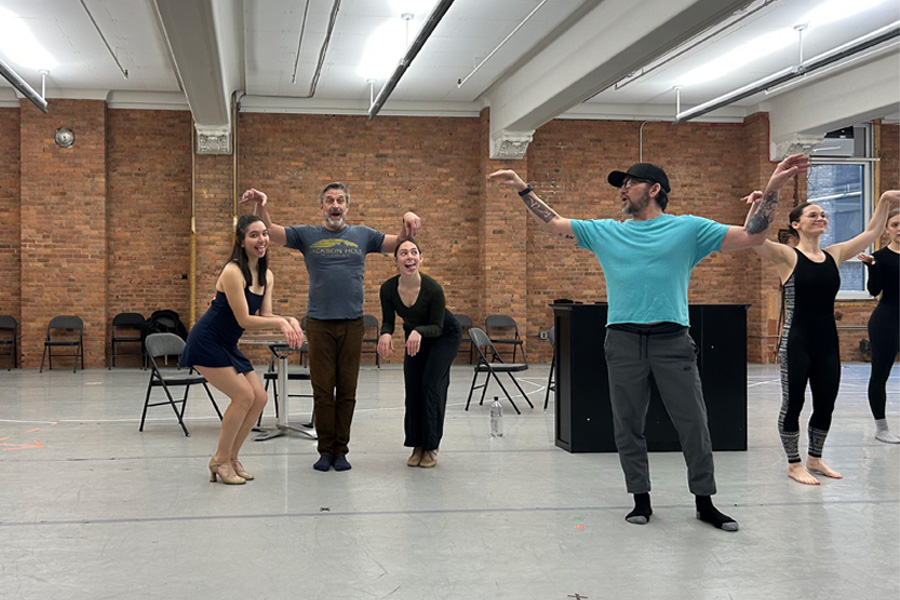
(left to right) Raúl Esparza and Andrew Palermo during a choreography rehearsal for Sweet Smell of Success. Photo by Tony Tenenbaum.
Andrew Palermo spent 17 years building a career in New York City, first as a performer, then as a choreographer and director, originating roles and choreographing Broadway productions including Allegiance and Meteor Shower. When Dennis Castellano, founder of the Department of Drama’s music theatre program, reached out about a newly created faculty position, Palermo had never planned on teaching 14 years later, staying active in the industry continues to inform his pedagogy.
“I'm a professor of research,” said Palermo. “For me, that's choreographing and directing shows. It's as much an education for the students as it is for my own.”
Last fall, Palermo choreographed a re-imagined version of the hit musical Sweet Smell of Success at Lincoln Center, working with Broadway heavyweights including Tony Award-winning performers Raul Esparza, Ali Louis Bourzgui and Tony Award-winning director Ted Sperling. The rehearsal process reflected a shift Palermo has seen across the industry, toward more collaboration and greater creative agency for performers.
“In this time, things are more collaborative,” said Palermo. “We want to give performing artists as much agency as possible, while still providing the guidance that is needed.”
As the department’s dance specialist within music theatre, Palermo also makes sure every student, singers and actors included, gets exposed to dance early on.
“I never let them say they’re not a dancer,” said Palermo. “Sometimes I’ll get a card from a past student saying that they never felt like they belonged in a dance studio, but now they know they can hold their own in an audition.”
For Palermo, confidence is woven into his creative practice. His work has repeatedly pushed past the traditional boundaries of dance, most notably with Creatively Able, a workshop he built from a piece he co-created with childhood friend Taye Diggs about autism. The work led him to teach people on the spectrum directly, most of whom had been excluded from neurotypical dance and theatre classes.
“I always ask these students, ‘What is your creative spark? What’s your creative voice?’” said Palermo. “The kids I work with range from having Asperger’s to being completely nonverbal. But it doesn’t change the fact that in class, we’re all creating something together.”
The workshop has been taught nationally and internationally and studied by UCI researchers and is one of several projects, alongside work addressing gun violence, that Palermo says grew out of curiosity rather than a predetermined plan.
“Almost everything I’ve created comes from trying to give voice to something that is underrepresented,” he said. “I get curious about a community, and by nature of that curiosity, it becomes something else entirely.”
Dancing since he was 5, Palermo is still discovering new creative outlets, including painting. For him, that willingness to keep experimenting is central to the work.
“That kind of fearless creation is crucial to being creative,” he said. “You have to be willing to fail. You have to be willing to fall on your face.”
That is also what Palermo hopes students take with them, whether they pursue Broadway or build careers far beyond the stage. Some students arrive with the skills and ambition to pursue a professional career in musical theatre. Others want to carry creative thinking into a different field.
“If a student has the skills and wants to go for it, I’ll give them everything, the business side, agents, unions, all of it,” he said. “The other kind of student is more holistic. They might become a Fortune 500 CEO, and that can be an exciting opportunity to serve them in what they are trying to do.”
That versatility reflects the reach of the arts themselves in society.
“The arts are everywhere,” said Palermo. “The table and computer I’m working from right now required art, design and creativity. People don’t understand the amount of jobs and money the arts put into our economy. The arts are the bedrock of society and culture.”
The numbers don’t lie. According to the National Endowment for the Arts and the U.S. Bureau of Economic Analysis, arts and cultural industries contributed $1.2 trillion to the U.S. economy in 2023.
Broadway alone contributed $14.7 billion to New York City’s economy and supported nearly 97,000 jobs in the most recent full accounting. Whatever the path in arts education students take, Palermo says the arts training itself is meant to travel with them.
“The arts give you room to challenge yourself, to challenge other people and to have some sort of impact on the world,” said Palermo. “To not just be an observer, but an active participant. It’s a challenging path. But the challenge is worthwhile.”
Sarah Koo Freeman
Music at Work
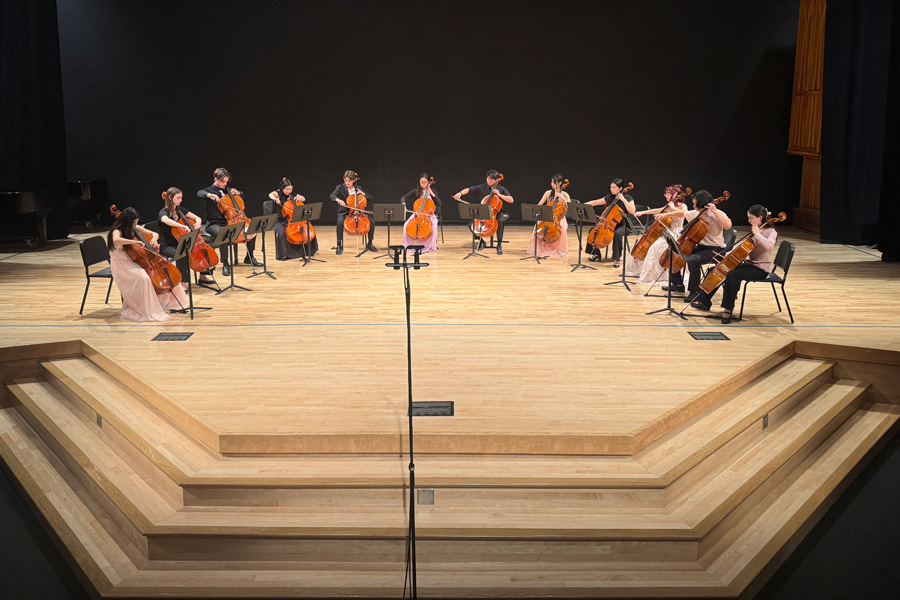
UCI Cello Studio performing Julius Klengel’s “Hymnus” in Winifred Smith Hall for a benefit concert for breast cancer research with UC Irvine. Photo by Bramwell Freeman.
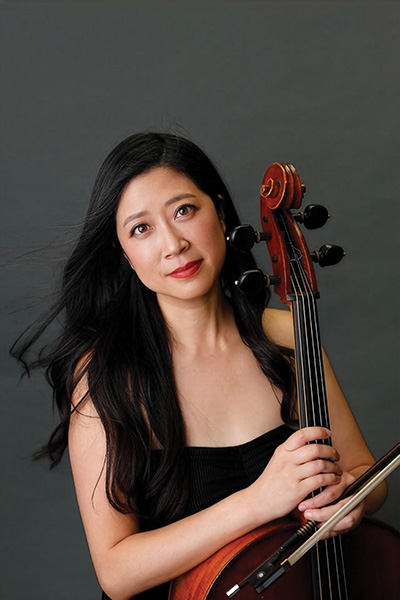
Sarah Koo Freeman trained at Juilliard before building a career as a performer then returned to the teacher who first put a cello in her hands to train as an educator herself. She has been at UC Irvine for nearly a decade, and this year was named both a Dean’s Honoree and a recipient of the Unit 18 Faculty Professional Development Award.
“I’ve been incredibly fortunate to have a career that has included orchestral playing, chamber music and performing,” said Koo. “But teaching is where I ultimately found my home.”
Now, most of Koo’s cello students are double majors. By her account, none of them want to give up music because they have seen what it adds to the rest of their education.
“I have a student going into pre-med, and I remember wondering whether there would come a point when he felt he had to choose between medicine and music,” she said. “But for him, music isn’t competing with that path — it’s part of what he believes will make him better at it. I think that says so much about the value of an arts education.”
The skills students develop through music extend well beyond performance.
“What I love is that students are learning all of these things by actually doing them,” she said. “They’re not just becoming better performers; they’re learning how to teach, lead, collaborate, organize, fundraise and turn an idea into something real.”
Some of that preparation happens through coursework. Some of it happens when students take an idea and turn it into something real.
In Winifred Smith Hall, Koo recently led a student-run concert benefiting the UCI Cancer Research Institute’s Lawson Lab, which studies metastatic breast cancer. The idea came from a student whose parent had been diagnosed and later went into remission.
“He came to me and simply asked, ‘Can we do something?’” said Koo. “The idea really came from him. Our role was just to give the students the support they needed to take that idea and make it happen.”
From there, the students took ownership. Roughly 40 cellists, ranging in age from 4 to 47, spent a month soliciting sponsorships before performing together. The concert began with a single cellist alone on stage, with musicians gradually joining one by one until all 40 were playing together.
The staging reflected how isolating a cancer diagnosis can feel, while a community of researchers, healthcare providers, family and friends stands behind each patient. What begins as one person facing something unimaginable ultimately becomes a stage filled with people standing alongside them.
“I want my students to realize that music isn’t just something we practice in a rehearsal room,” said Koo. “It can be a way of serving people during incredibly difficult moments. I want them to experience both the responsibility and the privilege of using their talents to help others.”
The project also gave students a direct connection to the work happening elsewhere on their own campus.
“There is something incredibly powerful about knowing that across campus, researchers are working on a problem that has touched someone we care about so deeply,” she said. “I may not discover the cure for breast cancer, but I can use what I know how to do — play music — to support and bring attention to the people who might.”
Students have already decided that they want to make the concert an annual tradition, wherever it ends up being held.
“I want students to begin living the life of an artist while they’re still here,” she said.
This philosophy is central to how Koo understands her work as both a musician and teacher, and to what she hopes to pass on to her students.
“Music and teaching have profoundly shaped my life,” she said. “I want my students to understand that having the ability to make an impact through our art is both a privilege and a responsibility.”
In a culture addicted to speed and optimization, Koo sees the arts offering something different.
“We live in a world that increasingly values speed and efficiency,” she said. “The arts ask something different of us: to slow down, to listen deeply, to connect with one another and to understand experiences beyond our own.”
Cyrian Reed
The Well-Rounded Dancer
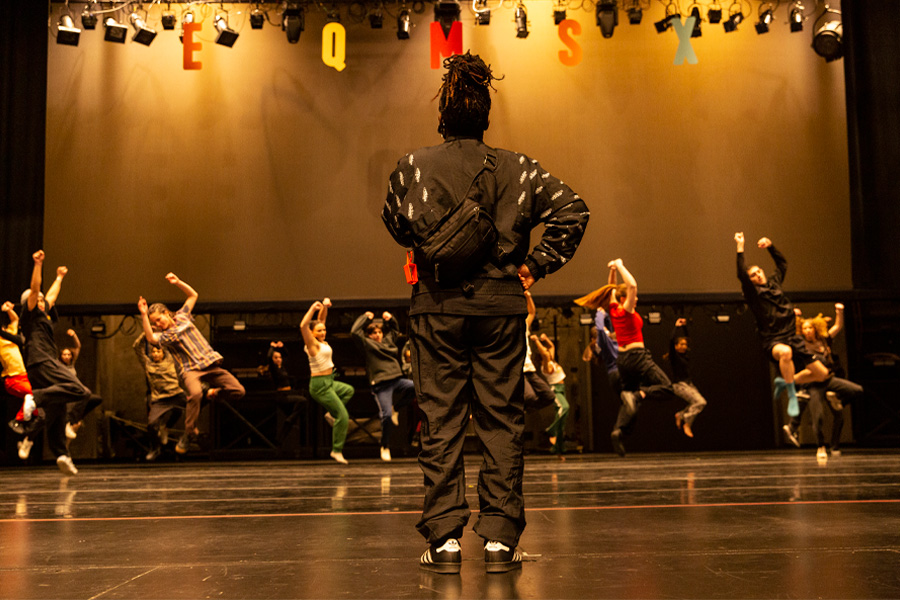
Rehearsal for Soul Intelligence, choreographed by Cyrian Reed, ahead of the Dance Visions performance at the Irvine Barclay Theatre. Photo by Rose Eichenbaum.
This year, Cyrian Reed received a 2025-26 UCI Arts Research and Innovation Grant to build REED ME, a digital performance assessment system designed to bring the embodied, practice-based values of hip hop pedagogy into online and hybrid learning spaces. It is the latest example of how far Reed’s imagination has stretched since she arrived at UC Irvine.
“I would have never thought about collaborating with a scientist or with the engineering department,” said Reed. “Being at UCI has opened up infinite possibilities for where my imagination and the intersection of research can enhance instruction within my lectures and demonstrations.”
Rather than reducing dance assessment to a score, REED ME centers choreographic understanding, musicality and adaptability. Through body mapping and camera-based performance, dancers learn how movement translates through the lens while receiving studio-informed feedback that supports reflection and continued growth. REED ME creates a more equitable and culturally responsive way to document, communicate and cultivate embodied knowledge beyond the traditional studio.
Reed is building the platform with electrical engineering and computer science professor Quoc-Viet Dang, with plans to use it in her own hip hop course, which is expected to enroll around 300 students across disciplines within the year.
“It is my job as the instructor to provide instruction that allows my students to participate in and embrace movement from diaspora dance forms,” Reed said.
Back when Reed was looking at universities to attend, she remarked that UCI Dance did not yet offer hip hop. Today, every dance major takes a required hip hop class, one Reed and assistant professor of dance Ariyan Johnson helped establish.
“A well-rounded dancer is a working dancer,” she said. “Every genre is important when you're studying movement.”
After graduating high school, Reed auditioned for and landed a commercial agent and soon found herself booking commercials and tours with artists including Beyoncé, David Foster, CeeLo Green and KC & The Sunshine Band, to name a few. At 23, after a slow stretch of bookings, a friend called asking her to cover a class at Cal State Northridge.
“I thought, how can I pay it forward? How can I help create dancers that would be better than me?” said Reed.
When she arrived at UC Irvine, Reed found that most of the dancers had no interest in becoming professional performers, which forced her to rethink what she was actually preparing them for.
“I have them look at dance and their practice differently,” said Reed. “Movement is life. Your practice can be used in many different employment pathways. You don’t have to be physically dancing to be living your artistry.”
Because Reed is interdisciplinary herself, she offers students that same framework. Whether it's operations, touring or working with marginalized communities, the path to a creative life takes many forms. For her undergraduates, she even offers a two-week pedagogy curriculum that is embedded in her level 3 class — where students build their own dance class and invite community members to take the final.
“I want my students to have confidence in themselves and believe in the hours and sacrifices they have made to be here,” shared Reed. “The day you stop, your dreams stop.”

From REED ME to the students she's nudged toward careers they never expected, Reed has spent her time at UCI Arts expanding what a life in dance can look like. Through it all, Reed returns to the same throughline.
“The arts matter because people matter,” said Reed. “The arts paint a portrait of the people.”
To learn more about UCI Arts, visit arts.uci.edu.
Please visit our secure direct giving page and make a gift to support UCI Arts today!