Continuity Leaves No Footprint Behind
 Share
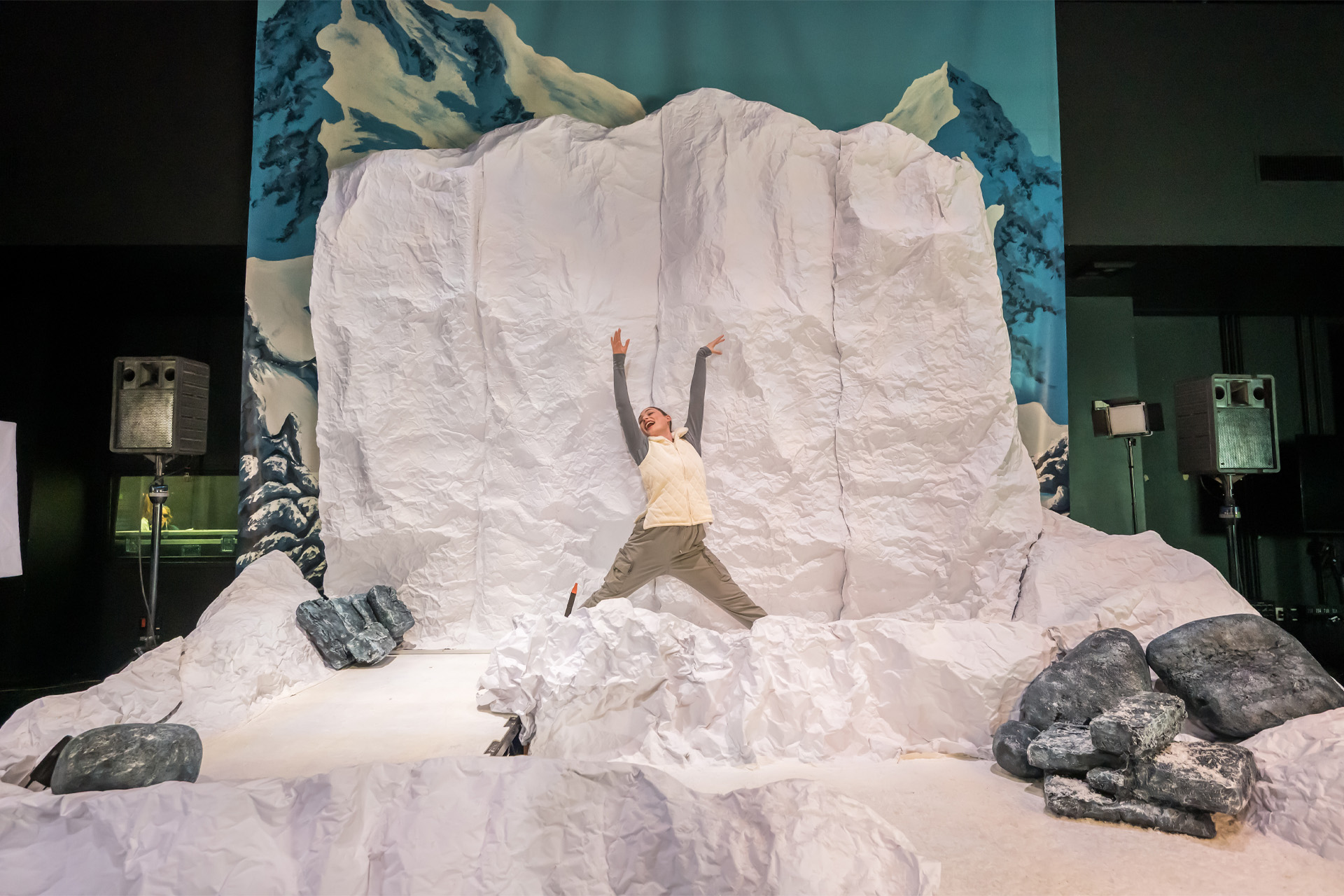
M.F.A. actor Zoe Rose Davidson in front of the production’s handmade glacier, built from salvaged materials, during a rehearsal of Continuity in the xMPL. Photo by Jeanine Hill.
Inside the fully sustainable UCI Drama staging of Bess Wohl’s climate dark comedy
By Ayiana Grana
Continuity, the play by Pulitzer Prize-winning playwright Bess Wohl, will be shown at the Experimental Media Lab (xMPL) at UC Irvine Claire Trevor School of the Arts from Nov. 6 to Nov. 14. The complex dark comedy features a film crew racing against the clock to finish a blockbuster movie about climate change while trying not to be crushed under the weight of their clashing artistic visions, ambition and the creeping reality of environmental destruction. Under the direction of Department of Drama professor Andrew Borba, this production of Continuity confronts the tension between art and activism head-on by implementing environmentally conscious pracbtices to create an entirely sustainable production, leaving behind zero carbon footprint. Tickets are available at arts.uci.edu/events/continuity.
“One of the subjects Bess Wohl questions in this play is the efficacy of activism,” said Borba. “That’s a profoundly pertinent question anywhere in the country these days, and it’s certainly relevant in a university.”
The decision to make Continuity sustainable was a choice that deeply aligned with the values of the production team and UC Irvine as a whole. Director Andrew Borba has spent the last few years working with a sustainable theater group that explores how the industry can be less wasteful. Both he and scenic facilitator and props designer Pamela Marsden are concerned with how often society chooses the easiest way to do something despite its effects on the environment.
Marsden points to the shift from glass bottles that could be reused to single-use plastics — just one example of a culture that has normalized disposing instead of reusing.
“Just because you can do something doesn’t mean you should,” said Marsden. “The easy way might save you something right now, but in the long term, there’s a price.”
This philosophy was a guiding principle for the production as the creative team disrupted the standard whenever they had the opportunity to choose sustainability over convenience. They found ways to integrate sustainability into countless aspects of the production, motivated by the goal of minimizing its carbon footprint. Lights are powered by solar energy and bicycles, while the costumes, designed by Genny O’Gilvy, are completely recycled. Projection designer and scenic painter Genesis Tanner painted the set’s stunning backdrop on an old piece of material that was ripped in three places and nearly thrown away. She also used paint donated by the Irvine community, rescuing it from its fate of sitting forgotten in a garage.
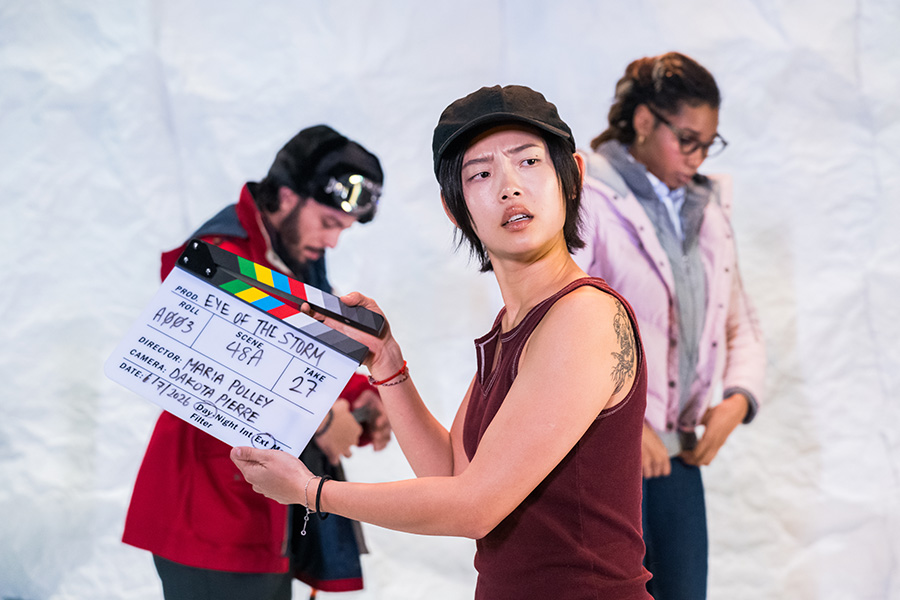
Actors rehearse a scene from Continuity, Bess Wohl’s dark comedy about a film crew shooting a climate change blockbuster, in the xMPL. Photo by Jeanine Hill.
Marsden worked in tandem with undergraduate scenic designer Colt McGuire '27 to pull materials from unconventional sources in order to build a glacier that acts as the scenic centerpiece of Continuity. They scavenged storage, giving new life to what appeared to be trash. Plastic sheeting, styrofoam and other supplies became glacier material. Marsden utilized her connections with Pacific Symphony Orchestra and the nonprofit organization Center Theatre Group to acquire resources that the groups had previously used.
The production’s unconventional approach was also shaped by financial limitations faced by the department.
“Due to budget cuts and the loss of graduate M.F.A. designers, we had neither the money nor the personnel to mount more than two fully staged productions this year,” said Borba.
Rather than allowing these constraints to limit their vision, the team used them as a motivator to reimagine the creative process. For Colt McGuire, who is a student of both engineering and drama, this meant embracing new approaches to design that go against habit. For this production, instead of creating a design and then finding materials to support it, he had to work backwards by designing based on the materials available.
“It was like an engineering jigsaw puzzle, and in order to find where everything fit, it was a lot of trial and error,” said McGuire. “Once I let go of planning everything out on paper and embraced the spontaneous process this show called for, it became a fascinating approach to building. The engineering felt almost sculptural, which I believe lent itself to the final look of the show, and in this way the process was a truly unique combination of creativity and engineering.”
McGuire found himself turning to older methods of design that aligned more with sustainability goals than using modern technology. In an effort to be power conscious, the scenic designer looked for an alternative to 3D computer graphics that wouldn’t require the same energy use.
“Instead of doing our drafting on computers, we instead did all of our drafting by hand on the backside of recycled paper from previous shows,” said McGuire. “It was slow and tedious, but it was a controllable part of the process that we were able to align with the goals of the show.”
The production’s resourcefulness was made possible by the community fostered within the theater world. McGuire and Marsden received many resources from groups they had worked with before on previous projects. McGuire described the overwhelming support as a “happy coincidence.” Within a few months of word being spread about the production, the scenic team found themselves in possession of more than enough materials.
“ The engineering felt almost sculptural, which I believe lent itself to the final look of the show, and in this way the process was a truly unique combination of creativity and engineering. ”
The full-circle moment led Marsden to reflect on the importance of connections and building professional relationships in the theater world, especially for students.
“We are interconnected,” said Marsden. “There is no separation. All the separations that are perceived in the world are just made up. They’re boundaries and borders designed to separate.”
This production exemplifies the benefits of building a network through supporting others. “I’ve been doing this for 25 years now,” said Marsden. “You help people when you can, and they help you when they can, and that’s how something like this gets built.”
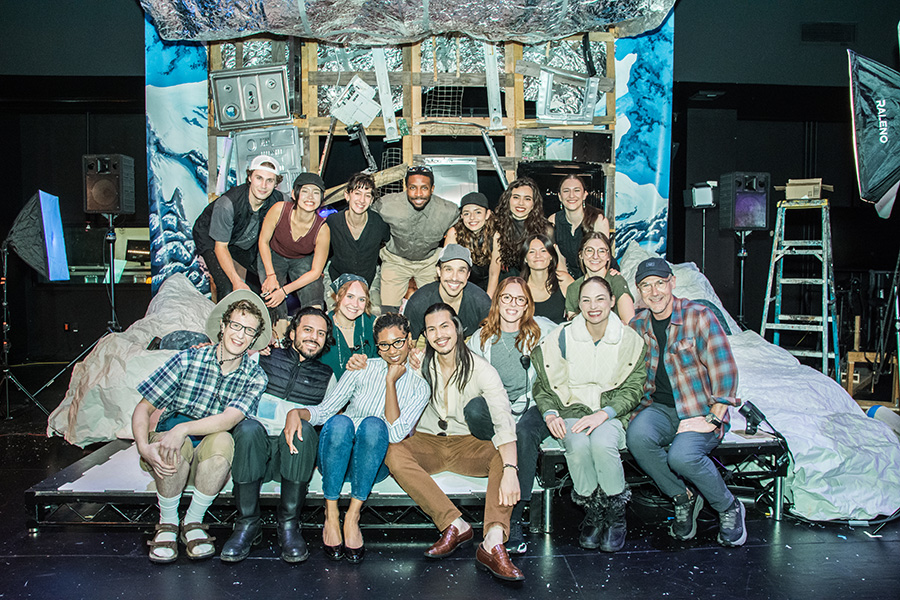
Andrew Borba (far right, first row), Jake Stiel (far left, first row) and the cast of Continuity gather on set during rehearsal in the xMPL. Photo by Jeanine Hill.
“ There is no separation. All the separations that are perceived in the world are just made up. They’re boundaries and borders designed to separate. ”
Borba also found a deep-seated sense of community forged through the challenge of working on an environmentally conscious production. There were fears of the limitations of the sustainable approach, such as worries about solar power working sufficiently on overcast days. But these struggles brought the creative team closer to each other as they embraced the uncertainty together.
“When we didn’t have an answer, we put our heads together and figured it out,” said Borba. “The surprise benefit of these challenges and working this way was community building. We got closer. That is probably the most precious thing I’ll take away from this production. “
Jake Stiel, M.F.A '27, the actor who plays a climate scientist in Continuity, is passionate about bringing more attention to the scientists studying and speaking up about climate change. Stiel also wants the audience to simply be curious enough to further investigate the environmental crisis and art’s role in society.
“I also hope people laugh and cry,” said Stiel. “That’s my goal as an actor. To make you laugh and cry and think!”
Ultimately, the creative team hopes to extend community to the audience as the play invites them to engage with the discussion around the future of the environment. Borba believes that plays do not exist to tell the audience what to think, but rather to invite them to ask questions and engage with their empathy.
“I’d like them to have those conversations with the people they came with, the people they sat next to, the people they go home to, and the people they meet in the grocery store,” said Borba. “And I’d like them to talk about the 75 minutes they spent in a room watching the astonishing talent of these emerging artists of the next generation who have created a world that is comical, entertaining, moving, and intellectually stimulating.”
For more information about Continuity, visit here.