Simon Penny's New Book Rethinks the Divide Between Skill and Intelligence
 Share
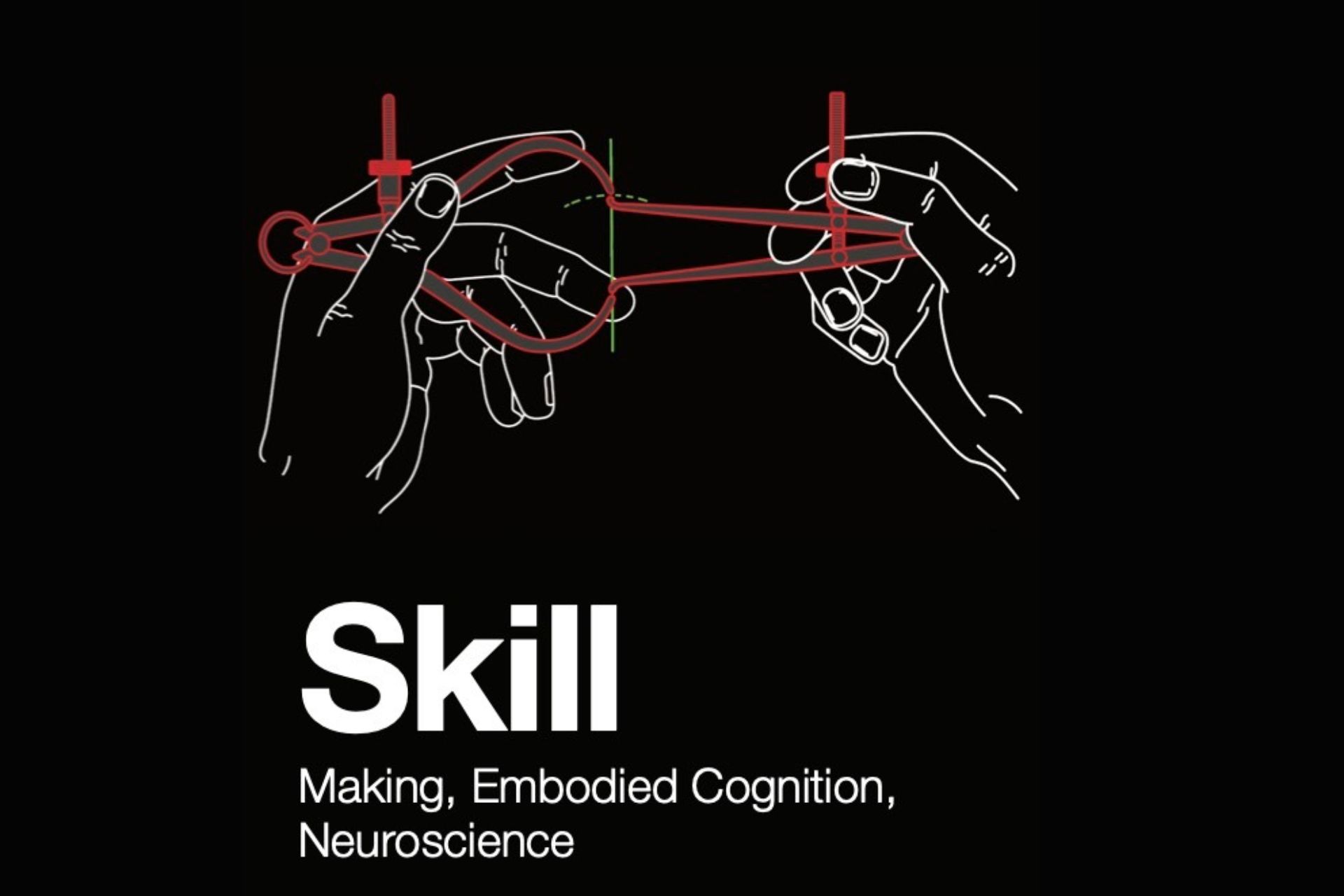
Cover design by Alex Kelly.
Skill arrives from Routledge in December
Simon Penny, professor of electronic art and design in the Department of Art at the UC Irvine Claire Trevor School of the Arts (UCI Arts), will release his new book, Skill: Making, Embodied Cognition, Neuroscience, with Routledge in December. The book challenges the long-held assumption that skill and intelligence are different. It argues that skilled practice, from crafting a tool to sailing a boat, is itself a form of cognition.
Penny, who also holds appointments in the Department of Music and the Department of Informatics, set out to find an account of skill that holds up experientially, philosophically and scientifically. The book draws on his 50 years of experience as an artist and maker working across diverse media, a practice that led him to question some of the basic tenets of the Western Enlightenment worldview.
"This book is an integrative, interdisciplinary discussion about the capabilities we call 'skill' and how they fit into contemporary perspectives on cognition," Penny said. "The larger philosophical conclusion, captured in the concept of neurophysiological holism, is that the distinction between intelligence and skill, like the distinction between mind and body, is false, or at least wildly oversimplifying."
The book opens by tracing the history of the philosophical ideas that shape how we think about the mind, consciousness and cognition. Penny shows that these concepts are culturally and historically constructed. Central among them is Cartesian dualism, the separation of mind and body, which he identifies as the root of the divide between skill and intelligence.
From there, Penny draws on neurophysiology and cognitive anthropology to build a new theory of skilled practice. It centers on proprioception, the body's sense of its own position and movement, and on how the senses and motor systems work together. The book then explores artisanal and other skilled practices, examining the roles of tools, structured spaces and cognitive ecologies. Later chapters consider how skills are taught and what this means for education more broadly. Penny closes by applying his framework to digital environments, the internet and artificial intelligence.
Published through a Routledge psychology imprint, the book is deeply interdisciplinary. It will be of interest to readers in anthropology, sociology, education and philosophy, as well as those working in psychology, cognitive science, neuroscience and computing.
Skill builds on Penny's long career at the meeting point of art, technology and the body. His previous book, Making Sense: Cognition, Computing, Art and Embodiment, was published by MIT Press in 2017, and a Chinese translation was published by Huazhong Academic Press in 2025. An artist and theorist known for building immersive, sensor-based systems for embodied interaction, Penny founded UC Irvine's Arts Computation Engineering (ACE) graduate program. Before joining UC Irvine, he was professor of art and robotics at Carnegie Mellon University.
To learn more about Skill: Making, Embodied Cognition, Neuroscience and to pre-order, visit Routledge. To learn more about Simon Penny's work, visit simonpenny.net.