
A New Play Finds Its Form at UCI Drama
 Share
Share
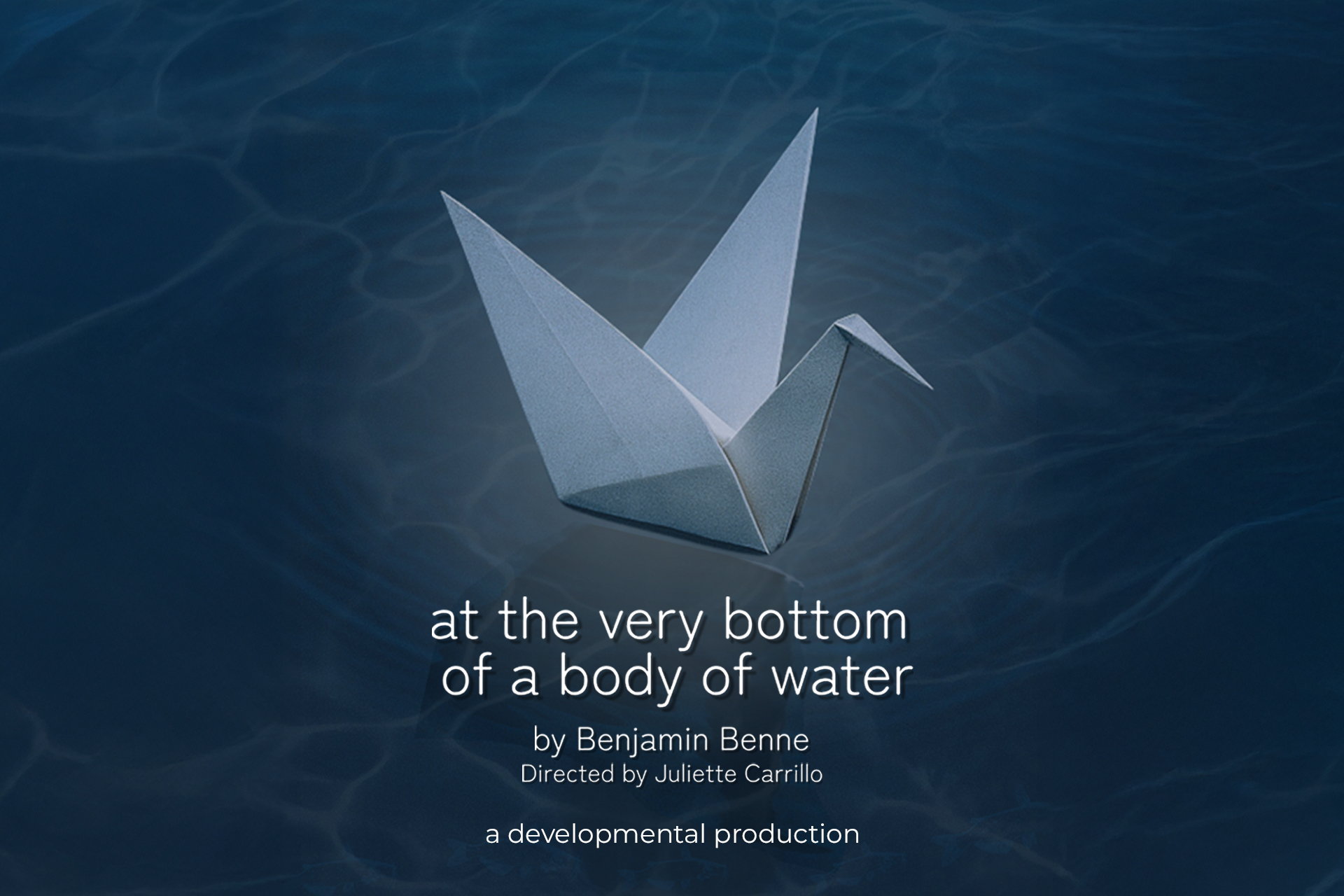
Image design by Fae Crane ('27), Kiya Ashley ('25) and Kate Sheehan ('27)
Benjamin Benne’s at the very bottom of a body of water, receives a developmental production at the Robert Cohen Theatre ahead of its world premiere
The UC Irvine Claire Trevor School of the Arts Department of Drama will present at the very bottom of a body of water, a new play by playwright Benjamin Benne, May 28 through June 6 at the Robert Cohen Theatre. Directed by UC Irvine Professor of Directing in the Department of Drama Juliette Carrillo, the production is a developmental staging ahead of the play’s world premiere at Boston Court Pasadena in Los Angeles, where Carrillo will also direct, running Oct. 22 through Nov. 29. Tickets and event information are available at arts.uci.edu/events/very-bottom-body-water.
The play follows Marina, a woman anchored in the weekly ritual of going to the local fish store, buying a catfish and making soup. When her usual fishmonger disappears, and that comfort is destroyed, the play asks whether destruction can open space for something deeper. Through surreal imagery and dreamlike sequences, the production explores grief, spiritual disconnection and the enduring ties of family.
For Benne, the ritual at the heart of the play is rooted in memory and geography. He grew up in Hacienda Heights, the same place where the play unfolds, and the catfish soup Marina makes each week mirrors a soup his mother, who is from Guatemala, would prepare from a nearby Asian market.
“When you ordered a fish, they’d take one out of the tank and butcher it right then and there,” said Benne. “The death of fish being treated as a mundane act strangely feels like the perfect depiction of grief: it’s violent and painful yet masked by the day-to-day routine of living a life.”
The play is the second work Benne wrote following his father’s death in 2013, a period of loss that paradoxically cracked open his sense of wonder.
“After my father passed away, the world felt so vivid. I’d oddly never felt more alive,” said Benne. “My brain was electric with metaphors that felt real: I’d look at the ocean and see light moving on it and think, ‘Sequins.’ I’d see ivy plants growing on a building and think, ‘That’s a marriage.’ I felt this compulsion to spend more time alone than I'd ever had before. For the first time in my life, I enjoyed my own company more than being around other people.”
That same heightened interiority nurtures the play’s dreamlike register.

Playwright
“The surrealism in this play came from a very intuitive place and a desire to show bigger feelings harbored within the body that might not be obvious to the naked eye,” Benne said.
The title itself was inspired by a Pablo Neruda poem Benne encountered painted on a tile during a solitary walk through a playground. The image lodged itself in his imagination: "We need to sit on the rim of the well of darkness and fish for fallen light with patience." From there, his mind traveled to the ocean floor, to the creatures that generate their own light where sunlight cannot reach.
"There should be a feeling of mystery which is awe-inspiring: maybe to some people that means danger and to others it can mean wonder and hope," said Benne.
Whether darkness signals danger or the possibility of wonder is a question the production asks its audience at every turn, and one that director Juliette Carrillo has been examining throughout the rehearsal process.
For UC Irvine, staging a developmental production is central to graduate-level training and research in drama.
"It's a huge gift to be able to try things out in front of a UCI audience, in this 'workshop' form," said Carrillo. "Building a play from the ground up is an extraordinary experience — I'm thrilled to be able to share this special and unique process with the UCI drama community.”
The visual world she is building moves fluidly between psychological realism and the uncanny, a balance she and Benne share as a foundational creative instinct.
"Both Ben and I love to explore alternate realities, while at the same time grounding the world of the play in psychological realism," said Carrillo. “I am working with the design team to create a physical world that is recognizable and relatable, but that can easily morph into a heightened dream world. The key is to find balance between these two worlds."
Translating that vision to the stage draws on the full resources of the Claire Trevor School of the Arts, with Professor Cyrian Reed of UCI's Department of Dance serving as choreographer alongside a design team that includes scenic design by Ashley Mendez, projection design by Yee Eun Nam, costumes by Lyall Hovey, lighting design by Rachel Fields, sound design by Matt Feeney, composition by Eliza Vedar and stage management by Sammie Moore.

Professor of Directing
It is a world that demands as much from its performers as its designers. Lourdes Castillo, M.F.A. ’27, who plays Roza Luz, Marina’s daughter, in a role that stretches from ages 5 to 15, has found in that challenge something deeply personal.
“It’s been especially meaningful to blend Spanish and English dialogue, which reflects how I communicate with my mother,” she said. “Growing up, I always felt there were phrases in Spanish that couldn’t fully be translated, so the most honest way to speak with my family became a marriage of both languages.”
Being rooted in a character who is explicitly a bilingual Latina has deepened Castillo’s understanding of what the role demands — and what new play development asks of a performer.
“Working on a new play requires a shared openness in the room: an understanding that the play already works on its own, and that we are there to add layers rather than impose them,” Castillo said. “I’ve truly never felt so connected to a character’s story.”
Above all, Carrillo wants the production to leave its audience with something essential.
“A cathartic release of emotion, a sense of trusting in humanity, a sense of being held,” Carrillo said.

M.F.A. '27
A post-show talkback with company members and scholars is scheduled for the May 31 matinee at 2 p.m. Open captions are also available for that performance.
at the very bottom of a body of water runs May 28 through June 6 at the Robert Cohen Theatre. For tickets and information, visit arts.uci.edu/events/very-bottom-body-water.
On opening night, May 28, Benne will lead a free public conversation, Beyond 'Want': The Storytelling of Awe and Wonder, Transformation and Desire, from 6 to 8 p.m. in the Contemporary Arts Center Colloquium Room. RSVP at zotspot.uci.edu.