
Drama Students Reimagine La Llorona in an Immersive Experience designed for Noguchi Gardens
 Share
Share

Veronica Kwon (scenic designer), Shilah Shurki (lighting designer), David Block (lighting designer), Hayden Kirschbaum (lighting designer), Efren Delgadillo (scenic professor), Lonnie Alcaraz (lighting professor), Kelsey Harrington (scenic designer), Genesis Tanner (scenic designer), Colt McGuire (scenic designer), Rachel Fields (lighting designer), not pictured Ashley Mendez (scenic designer) presenting Boundless Entertainment's immersive reimagining of the La Llorona legend, digitally staged in Costa Mesa's Noguchi Gardens. Photo by Diana Kalaji.
Lighting and scenic designers in the Digital Imaging course collaborated on a digitally rendered installation that honors the legend's cultural roots and the Costa Mesa sculpture garden that inspired it
Ten student designers in the Department of Drama recently presented their final projects for the Digital Imaging course, unveiling a collaboratively designed immersive experience digitally set in the Noguchi Gardens near South Coast Repertory in Costa Mesa. For the final, students formed their own themed entertainment company, Boundless Entertainment, dedicated to sharing immersive stories of underrepresented communities with safety at the forefront. The company's reimagining of the La Llorona legend marked the culmination of 10 weeks of research, design development and creative collaboration.
"The Digital Imaging course has always centered on three core principles: design, presentation and collaboration," said Lonnie Rafael Alcaraz, lighting designer and lighting design professor at UC Irvine Claire Trevor School of the Arts. "This final project exemplified those goals exceptionally well. The students worked closely together to develop a cohesive design vision that was both compelling and engaging for the audience. Their collaboration was evident throughout the presentation, which showcased ten weeks of exploration, refinement, and creative problem-solving. Just as importantly, it demonstrated the strategies and communication techniques designers use to clearly convey their ideas and bring a design concept to life."
Co-taught by Alcaraz and Efren Delgadillo Jr., associate professor and head of scenic design, the course brought together four graduate students and six undergraduate designers across the lighting and scenic design disciplines. Working in teams, the students developed a shared design vision for the immersive installation, translating the serene landscape of the sculpture garden into a digital environment.
When offered a list of possible stories to adapt, the students gravitated toward La Llorona for the chance to push back against her familiar portrayal as a ghostly, vilified figure in post-colonial Latin America. The teams researched Aztec culture to uncover the truth of her story before colonization and ground the experience in the legend's deeper roots. They also visited the gardens to understand the scale and versatility of the space firsthand.
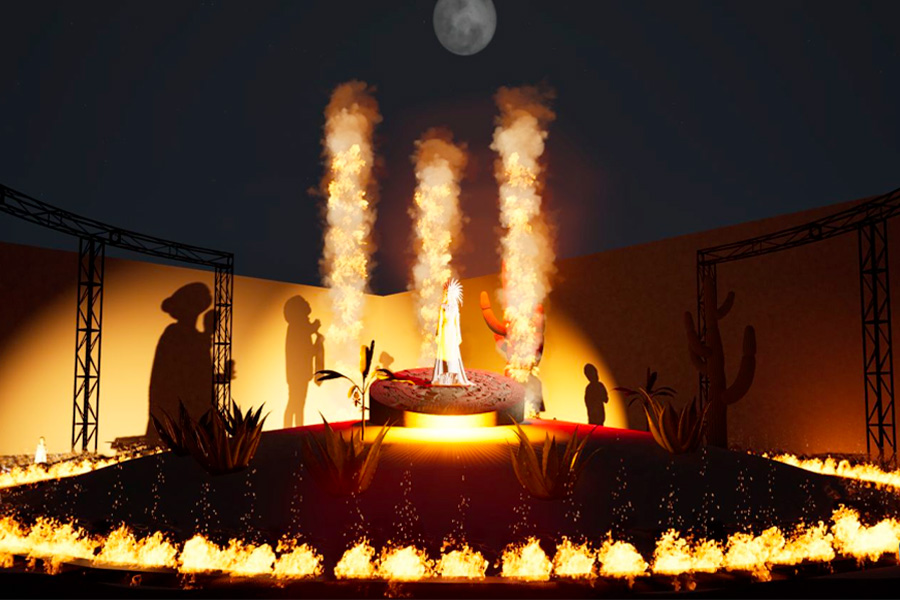
A digital rendering titled "Séance: The Children," from Boundless Entertainment's immersive reimagining of the La Llorona legend, depicts a robed figure at the center of a fire-ringed desert altar, framed by columns of flame, agave and saguaro beneath a full moon.
Accessibility and safety shaped the designs throughout. Renderings and walkthroughs featured visitors of diverse body types, including wheelchair users, and the students noted that the garden's large, open layout lends itself to an ADA-accessible experience. Even the production's boldest element, towering pillars of fire and a dramatic ring of fire, was engineered with safety as the top priority: flames were positioned to protect the garden's architecture, barriers separated audiences and performers from the fire and the teams developed alternative effects using haze and mist should real flame prove unworkable.
The students were equally mindful of the garden itself, treating its connection to the California ecosystem as something to preserve rather than design over.
"Early on, our mentors said we have to preserve what Noguchi means, and that is the California ecosystem," said Shilah Shurki ’28. "Rather than working against that, we worked it in line with the destructiveness in La Llorona's story. California has so many fires, and mustard seed flowers are extremely destructive in the California ecosystem and a big cause of fires. Having that destructiveness within the seance scene merges so well."
"The unique part of this group this year was the authenticity, and we asked them to lean into that and respect Noguchi Gardens as a space," added Alcaraz. "There was a wonderful responsibility that they took on to tell a real story."
The course is one of the few of its kind in the country, taught in one form or another since the early 2000s. Bringing scenic and lighting designers together with a scenic professor and a lighting professor to create collaborative projects is central to the department's approach. Every three years, the class expands into a Theme Park project that adds costume and sound designers, along with stage managers, uniting designers across all disciplines.
Learn more about the Department of Drama and its design programs at arts.uci.edu/drama.