Playing in Real Time
 Share
Share
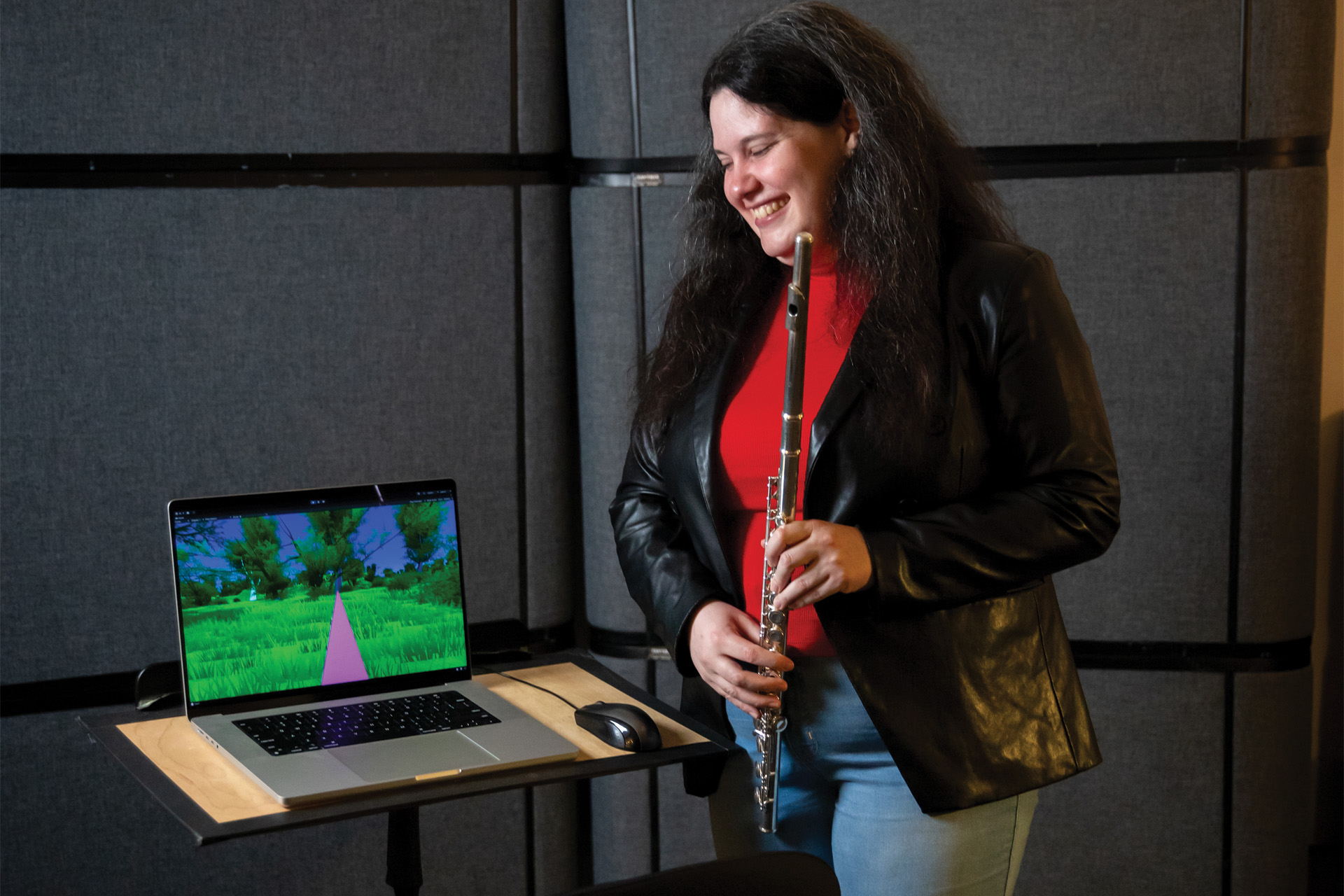
Rebecca Larkin with her dissertation project, Duet for Flute and Video Game. Photo by Emily Zheng.
Rebecca Larkin, Ph.D. ’26 builds music that responds in the present
By Diana Kalaji
A composer, flutist and game developer, Rebecca Larkin is a Ph.D. candidate in Integrated Composition, Improvisation, and Technology (ICIT) in the Department of Music at UC Irvine Claire Trevor School of the Arts. Her work investigates how sound can guide attention, sustain tension and shape decision-making as it unfolds. That sensibility, shaped early through video games, now anchors an interdisciplinary practice that merges live performance, interactive systems and play.
Larkin’s research sits at the intersection of music and gaming, where composition is not fixed, and outcomes are never predetermined. Instead, music evolves through interaction. Player choice, bodily movement and sonic response are inseparable. For her, technology is not a backdrop to creativity. It is a space where music becomes active, responsive and shared.
Nonlinear Sound
Larkin grew up in Burlington, Vt., where she began playing the flute at age 9. Drawn to the instrument’s timbre and expressive range, she gravitated toward music that felt imaginative and expansive. Early influences ranged from classical repertoire to Jethro Tull, whose unconventional use of flute helped her understand the instrument’s versatility.
By high school, video games had become just as formative as concert music. Unlike film or television, games demanded sustained attention. They would not move forward without player input, and the music functioned differently as a result.
“What makes games so special is that they’re non-linear,” said Larkin. “In a film, the timing is locked. In a game, the player might stay in one place for a long time or move quickly through a scene. The music has to be flexible enough to support both.”
That realization became especially clear while playing Kingdom Hearts, a game she remembers playing repeatedly. Each failed attempt returned her to the same cinematic sequence, with the same dialogue and score, until she noticed how the music impacted her emotional response and motivated her to try again.
“ What makes games so special is that they're non-linear. ”
Ph.D. '26
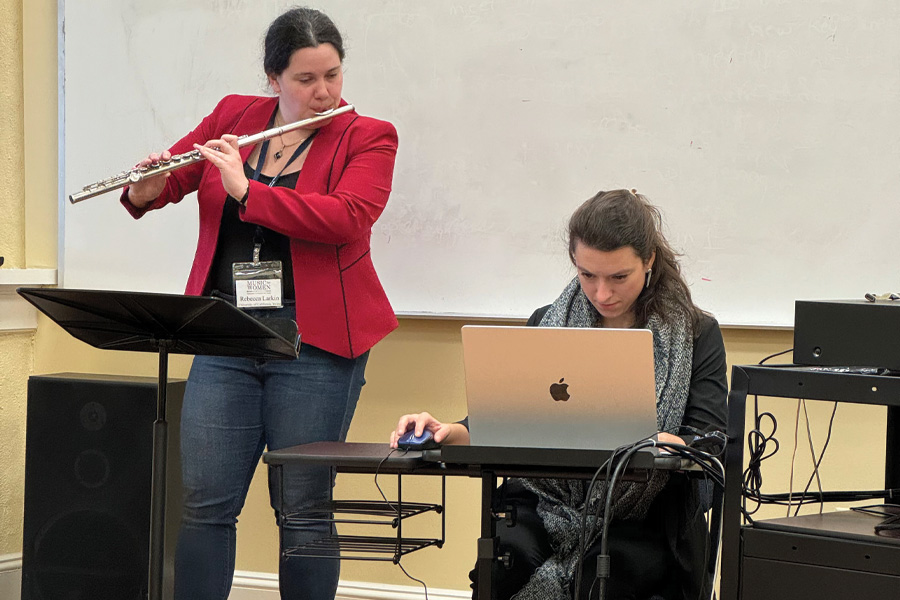
Rebecca and student play Duet for Flute and Video Game. Photo by Cara Haxo.
“I kept hearing the same music over and over,” recalled Larkin. “It hit me how much the scoring was doing the storytelling work.”
Larkin carried that awareness into her academic training. She earned a bachelor’s degree in flute performance at Ohio Wesleyan University, followed by a master’s degree in composition at the University of Oregon. While pursuing a classical path, she remained focused on composing for games, eventually finding an independent game development community in Eugene called BitForest, which emphasized collaboration, experimentation and rapid creation.
Local game jams introduced her to a creative culture that valued process over perfection. “It was freeing,” said Larkin. “You could try something strange, see how it worked and learn from it right away.”
Embodied Technology
That approach ultimately led Larkin to UC Irvine’s ICIT program, where interdisciplinary work is central to the curriculum. ICIT’s emphasis on composition, improvisation, performance and technology provided the structure she needed to pursue research that did not fit neatly into a single category.
Her dissertation project, Duet for Flute and Video Game, is a two-player cooperative work that integrates live flute performance with a custom-built video game. One participant plays the game, often a volunteer encountering the work for the first time. The other performs on flute, with the instrument’s pitch and gestures tracked in real time to create in-game events.
“The flute is not playing alongside the game,” said Larkin. “It is essential to how the game functions. Without the flute, certain things would not happen.”
Built using the Unity game engine, Duet for Flute and Video Game places agency at the center of the musical experience. The performer and the player share responsibility for shaping the outcome, creating a work that is different every time it is played.
“At the core of my research, I believe that playing a video game and playing improvised music are based on the same principles,” said Larkin. “Both require listening, reacting and making decisions in the moment.”
The project also reflects ICIT’s broader philosophy, which encourages students to move beyond traditional notation and Western musical frameworks. For Larkin, that shift was transformative.
“My work used to exist almost entirely on the page,” she said. “Now, sometimes there is no score at all.”
Technology, in this context, is not separate from performance. It is deeply physical and personal.
“I do not know if I think of technology as an extension of the flute,” said Larkin. “But it is definitely an extension of me.”
In 2024, Larkin was named a Medici Circle Scholar, which provides funding to specific projects for students in the arts.
The award supported her in presenting her research at Ludo2024, a video game music conference in Mataró, Spain. Larkin was able to engage with scholars in ludomusicology, the study of music and games. On campus, she has also participated in Grad Slam, UC Irvine’s three-minute research pitch competition, where she translated these complex ideas for a broad audience.
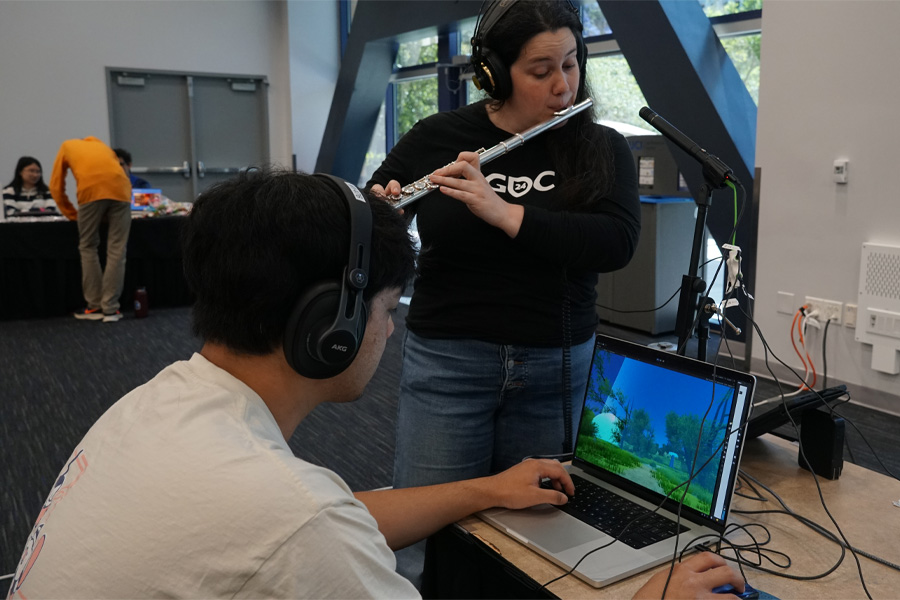
Rebecca Larkin and a student at a UCI Video Game Development Club meeting, playing Duet for Flute and Video Game.
“Grad Slam forces you to clarify what really matters,” said Larkin. “You cannot assume people already understand your field.”
Larkin credits ICIT faculty, particularly her advisor, Kojiro Umezaki, with supporting the project from its earliest stages and encouraging her to pursue a research path that bridges performance, technology and play.
“Rebecca’s work interests me because there’s a language that has developed around explaining musical improvisation from within the discipline of music that has the potential to shed light on, for example, how individuals express themselves creatively in video game play and vice versa,” shared Umezaki. “This project Rebecca is pursuing is very much in the sweet spot of the ICIT Ph.D. degree, where pathways connecting a plurality of disciplines are activated in the interest of opening up new territories in music and the arts."
As she prepares to complete her Ph.D., Larkin remains focused on creating immersive, cooperative experiences that invite people into sound. Whether through games, performance or future teaching, she is committed to building spaces where music responds, listens and evolves.
For her, the future of music and technology lies not in automation but in connection. In systems that reward attention, curiosity and play. In moments where sound becomes something shared, shaped together, and fully alive in real time.
“I want to create experiences where people feel involved,” said Larkin. “Where music is not just something you hear but something you participate in.”
To learn about the ICIT program, visit arts.uci.edu/music/programs/icit. To learn more about Rebecca Larkin’s work, visit her website at rebecca-larkin.com.
Please visit our secure direct giving page and make a gift to support UCI Arts today!