At New Swan Latine Artists Bring Themselves to Shakespeare
 Share
Share

(Left to right) Heriberto Cruz Jr. and Alejandra Villanueva perform in the New Swan Shakespeare Festival’s The Merry Wives of Windsor Cove. Photo by Jesus Enrique López Vargas.
A fall panel looks back at The Merry Wives of Windsor Cove and the artists who shaped it
This summer, New Swan Shakespeare Festival issued its first public casting call for Latine actors to play purposefully written Latine characters. For producing director and stage management alumnus Jesús Enrique López Vargas, M.F.A. ’21, that choice answers a question he put to the audience at the event, Shakespeare in Brown Bodies: Latine Performance at New Swan.
“Who gets to decide who joy belongs to?” said López Vargas. Who gets to decide who can laugh on our stages or on television? That’s the producer.”
The conversation looked back at The Merry Wives of Windsor Cove, the festival’s 2026 musical adaptation set in a Southern California beach town in the 1950s. Third-year drama M.F.A. candidate Heriberto Cruz Jr., who played Doctor Cayo, joined Alejandra Villanueva, who played Mistress Quickly, on a panel moderated by Kyle Grady, associate professor of English at UC Irvine. The event was part of New Swan’s 2026-27 “Shakespeare at Home” series, co-sponsored by Illuminations: The Chancellor’s Arts and Culture Initiative.
Who Decides?
López Vargas, who was born and raised in Mexico and first came to the United States at 11, called the casting call a step in the right direction and said decisions about whose stories reach the stage are among the most important a producer makes.
“As producers of performance works, we don’t just entertain,” said López Vargas. “These stories have the power to validate us or challenge us, to represent us and to teach us.”
His original pitch for the event’s title was “Beautiful Brown Bodies,” inspired partly by the show itself and partly by the growing number of producers of color helping shape casting decisions across the theater industry.
He pushed back on the idea that Shakespeare has to be played white or European by default. In Mexico, he said, companies set the plays where and when they are performed, and New Swan does the same in Irvine. Cayo and Quickly were not “playing brown,” he said.
“They just happened to be brown, because brown people in beach towns in Southern California in the 1950s did exist,” said López Vargas.
He pointed to Lourdes Castillo, a third-year Drama M.F.A. candidate seated in the audience who played Juliet in New Swan’s Romeo and Juliet this summer and recently won Orange Curtain Review’s Best Young Actress award for 2026.
“She did not speak a single word of Spanish on that stage,” he said. “Yet Juliet was Latina, because Lourdes is Latina. It can be that simple.”
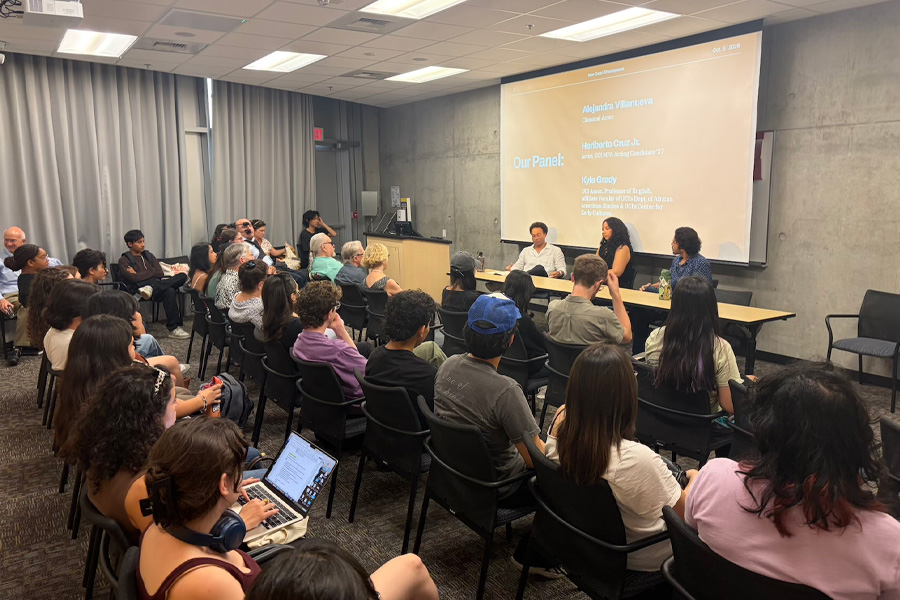
From left, Kyle Grady, Alejandra Villanueva and Heriberto Cruz Jr. speak to a full room during the Shakespeare in Latine Bodies panel at UC Irvine.
Inclusive Language
Villanueva, a San Diego native raised in Tijuana, said Shakespeare intimidated her as an undergraduate at USC because English is her second language. A professor reframed it for her. Speaking another language put her a step ahead, he told her, because Shakespeare is a language of its own.
Before Merry Wives, she performed in The Old Globe’s Globe for an all-touring production of Julius Caesar, which played community centers and correctional facilities. Audiences there needed Spanish, so she translated portions of the text herself. She brought that experience into the New Swan rehearsal room.
Cruz grew up in Newington, Conn., just outside Hartford, and found Shakespeare as a high school junior when he auditioned for Twelfth Night.
“As an actor of color, I’ve always felt that there is something beautiful, rebellious, strong and proud in being an actor of color presenting these timeless stories,” said Cruz. “I don’t have to live in this world that I created for myself. I can live in Verona. I can go to Illyria.”
Cruz has been actively learning Spanish for about 12 years, and the Spanish he knows carries the Puerto Rican expressions of his family. That came into focus early in rehearsal, when he used a phrase his mother would say to calm his father in traffic. In Puerto Rico it means “take it easy.” In Mexican Spanish it means something far less family-friendly, and Villanueva’s reaction opened a real conversation between the two actors about where their characters came from.
“We realized we actually can’t ignore his identity,” said Villanueva. “He’s Puerto Rican and I’m Mexican, and there’s even more nuance to that.”
From there, each actor wrote their own Spanish. Villanueva said she could not write Cruz’s lines in Puerto Rican slang, because you can only speak from your own lived experience. She also worked to keep each thought whole in one language rather than switching mid-line, since Shakespeare writes in full thoughts and breaking them can break the actor’s through-line.
Cruz credited that partnership with giving him room to take risks.
“I’m all about a bold swing, but feeling safe to swing boldly, trip and still get caught by your scene partner,” he said. “It’s just easier to take those risks with someone who looks like you.”
Both actors credited director Eli Simon, chancellor’s professor of drama and New Swan’s founding and producing artistic director, with protecting that process. When they flagged a line that undercut Quickly’s intelligence, he agreed to change it.
“He was so respectful of the language and our identity,” said Villanueva.
López Vargas noted that Villanueva was paid for leading the language and cultural work in the rehearsal room, and he urged students in the audience who take on similar work to ask to be compensated for it.
“It is not easy translating,” he said. “You’re worth a lot.”
The response from audiences has been personal. Villanueva recalled a young woman who found her after a performance, still laughing at a joke delivered in Spanish, who said Quickly reminded her of her own sister. During the Q&A, an audience member told the panel that Castillo’s Juliet was unlike any he had seen, because she brought her neighborhood, the energy of where she grew up, into the role.
Villanueva is now touring with The Old Globe’s Globe for All production of Macbeth. López Vargas closed his opening remarks with what he sees as New Swan’s real magic.
“We make each other stronger, we make each other better,” he said. “And that includes our patrons just as much as our artists.”
To learn more about the New Swan Shakespeare Festival, visit newswanshakespeare.com. To learn more about the Department of Drama, visit arts.uci.edu/drama.