Body of Work
 Share
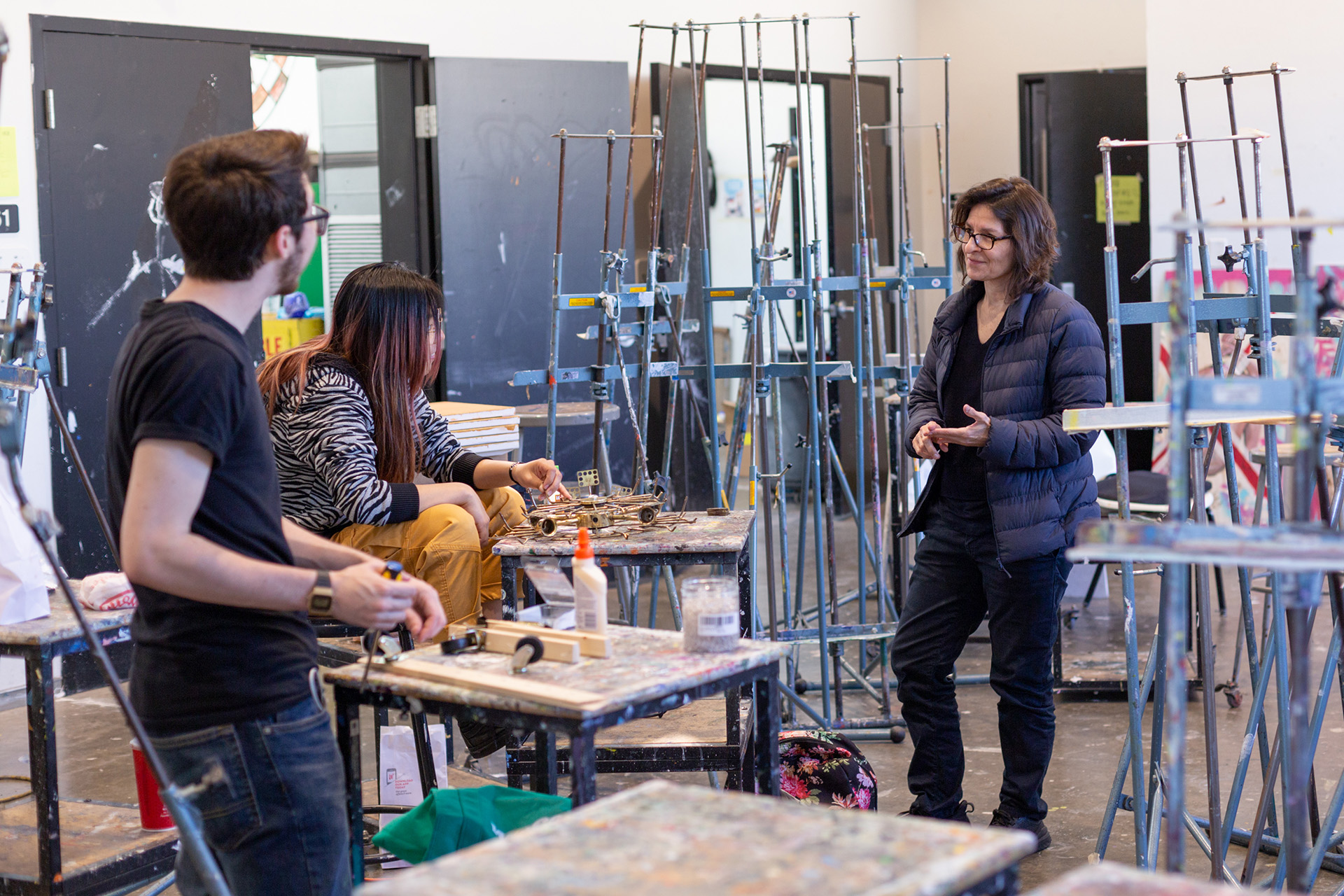
Monica Majoli (right), professor in the UC Irvine Department of Art, works with students in the studio. Photo by Yubo Dong.
Art professor and Guggenheim Fellow Monica Majoli looks for the female gaze
By Christine Byrd
Monica Majoli’s three decades of artmaking have largely explored male bodies and sexuality through provocative paintings evoking power and mortality. The female body, however, has given her pause.
“I’ve always been hesitant about engaging with the female form in my work because it’s been exploited and exhausted in so many ways, historically speaking,” said Majoli, professor of art.
She is now facing that challenge with the help of a 2026 Guggenheim Fellowship, which will support a female-focused corpus, Ovulars. The award recognizes the exceptional potential of a proposed project, as well as the artist’s previous work, which for Majoli includes pieces held in prestigious public collections such as the Museum of Modern Art in New York, the Los Angeles County Museum of Art and the Pinault Collection in Paris.
With this year’s addition of Majoli and art alumna Samira Yamin, M.F.A. ’11, to the 101st Class of Guggenheim Fellows, the Claire Trevor School of the Arts now counts 27 Guggenheim Fellows, including six current faculty in the Department of Art.
The Ovulars
The seed of Majoli’s Guggenheim-supported project was planted in 2018, when she stumbled across a series of photojournals titled The Blatant Image from the early 1980s, featuring photographs by Tee Corinne, Honey Lee Cottrell and Joan E. Biren, among others. Although their feminist art had been influential to Majoli’s own self-discovery as a young woman, these photojournals captivated Majoli in a new way as she began looking back on her life and career. The documents shared the experiences of lesbian feminists at a commune in rural Oregon, who came together for several summers to hold photography workshops they called Ovulars — a feminist twist on “seminar,” which comes from the word “semen.”
“They were in search of the female gaze, taking an approach to photography that changed familiar power dynamics and equalized the relationship between subject and creator,” Majoli explained. This included both the photographer and subject being nude, composing images collaboratively and avoiding words like “shoot” to describe the process. “There was primarily a drive to conjure a lesbian image, capture authentic, embodied experience and view women’s bodies in a way that wasn’t objectifying.”
Not restricted to photography, the women at the Ovulars were also exploring social issues of the day.
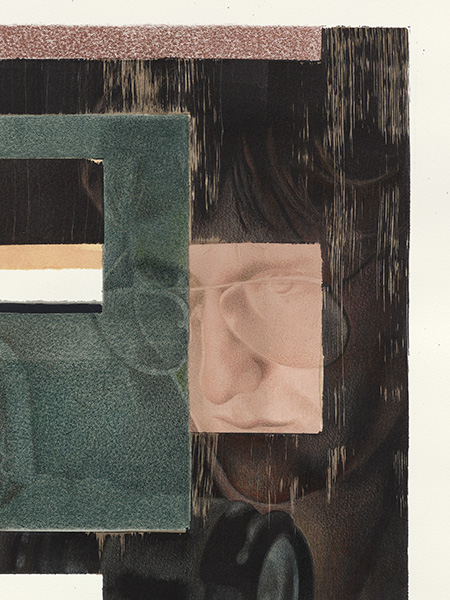
Monica Majoli, Tee Corinne by Joan E. Biden, Ovular 1980, 2025, colored pencil, acrylic ink on lithograph 21” x 15¼”. Courtesy of the artist.
“Much of what they shared was about their collaborative dynamics, including the challenges they experienced in negotiating shared labor and issues related to class, inequality — issues we’re grappling with today,” said Majoli. “The women were trying to find a way to live and think differently by creating self-sustaining communities around the idea of communal learning and consciousness-raising through photography.”
“There’s a remarkable optimism to their endeavor,” she added. “Just tapping into it is a beautiful feeling.”
Majoli began researching the archives of lesbian feminist photographers and considering questions about the precarious nature of lesbian visibility and culture-driven, in part, by her own fear of a trend toward self-erasure among lesbian women. Since embarking on the project, it’s become even more urgent.
“I really think there’s a broader purpose to the work now that I didn't foresee,” said Majoli. “These ideas are important to all women because we exist in an aggressively masculine cultural environment right now.”
Majoli likes to spend up to 10 years on a project, gestating before moving to execution. While she ultimately plans to produce oil paintings on panel for the project, she is currently in the drawing stages. Earlier this year, she showed a colored pencil-on-lithograph series at Hoffman Donohue in Los Angeles. She described drawing the photographers who led Ovulars as a way to immerse herself in the summer workshops, imagining herself there, communing with them. This fall, Majoli will show drawings and archival materials from the Ovulars set in the June L. Mazer Lesbian Archives in West Hollywood.
Transformative Experiences
For the last 20 years, Majoli has taught in the Department of Art, mentoring countless undergraduate and graduate students. Majoli emphasizes direct engagement with work in the world and in her courses. She no longer assigns reading to her students, rather focusing on close visual observation in person and students’ written accounts of experiential encounters with works of art.
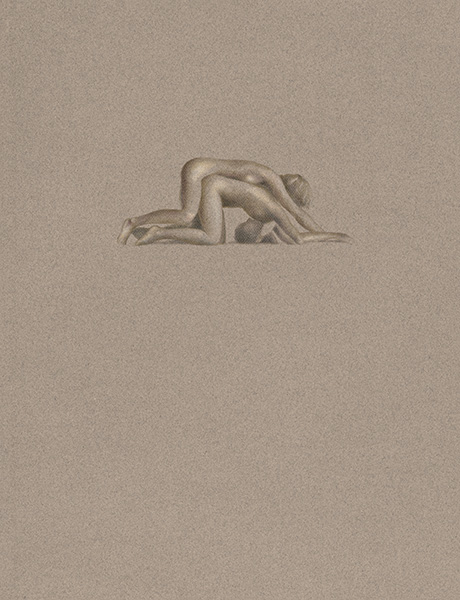
Monica Majoli, Ovulars 1, colored pencil 25 5/8" x 19 5/8". Courtesy of the artist.
“One of the most gratifying things as an artist is when someone receives what you intended when making the work — that this silent object has communicated something others can articulate or feel,” she said. “That’s where the mystery of art is, and I try to maintain focus on that.”
Majoli’s mentees agree that her deeply thoughtful feedback is one of her strengths.
“Monica acknowledges her students as artists and their work, no matter its look, as a declaration of a lived experience,” said Mona Welch, M.F.A. ’24. “It is this constitution that makes her a remarkable professor. It is the one that makes her a brilliant artist. And it is the same one that shows us how to be artists in the world.”
One of Majoli’s favorite opportunities for UC Irvine Arts students is the Medici Circle Scholarship, which supports a research project within their respective disciplines under the mentorship of a faculty member. Since 2022, Majoli has mentored three Medici Scholars in the Department of Art and witnessed its profound impact on artists including Welch, who applied at Majoli’s urging.
“While the Medici scholarship took me to Berlin because of a desire for a spiritual return to a consequential familial site, the work that came out of that summer was not contingent on that, but rather that I was elsewhere, away from Irvine, from Los Angeles, from my studio,” said Welch. “It was that psychic shift that propelled me and my work into an electrifying new register when I returned; and it is the same one that Monica's perspicacity determined as a forecast and primary condition to my practice. She was right.”
Even beyond the financial aspects, support from Medici patrons provides much-needed encouragement for graduate students.
“This infusion of belief that comes from knowing someone from outside the university is interested in your project, willing to invest in your work and wants to create these moments of insight for you — that becomes a transformational experience for the artist,” said Majoli. “As artists, we need these relationships with patrons, and the Medici patrons are creating an incredible sense of support with impact beyond the material.”
In that sense, it’s not unlike the Guggenheim fellowship for a seasoned artist like Majoli: “It’s complicated because everyone is deserving of support,” she said. “But when others see the value of your work and feel you’re worthy of recognition, it’s very moving.”
Lighting a Spark
Samira Yamin, M.F.A. '11
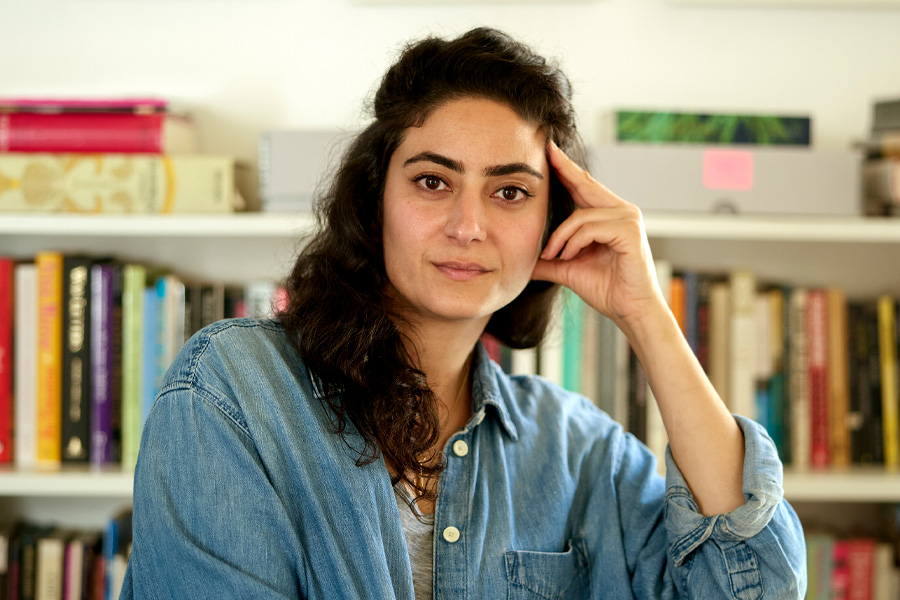
Samira Yamin. Courtesy of Metro Art (Los Angeles County Metropolitan Transportation Authority).
To Samira Yamin, M.F.A ’11, it’s “mind-boggling” to be in the same class of Guggenheim fellows as art professor Monica Majoli, a mentor from her time as a UC Irvine graduate student.
“Monica’s practice is rigorous, thoughtful and sincere” Yamin said. “She’s been a beacon for me any time I’ve felt anxious that I’m not making enough work, or that it’s not big enough or loud enough.”
Like her mentor, Yamin takes a slow, thoughtful pace with her artistic practice. The Los Angeles-based multidisciplinary artist often uses photography to critique representations of conflict in what she describes as “a nebulous Middle East.” Her Luminous Zone project, supported by the 2026 Guggenheim Fellowship, dates back to when she was an undergraduate at UCLA and mistook a newspaper photo of a wildfire for a war image — sparking a fascination with fire as spectacle.
Already, Yamin’s work is part of the permanent collections of the Los Angeles County Museum of Art, the Rose Art Museum at Brandeis University and the Smart Museum at the University of Chicago. In 2022, her art was featured in a public commission for the Los Angeles County Metropolitan Transportation Agency.
Her artistic practice has already made her a peer to her former faculty and mentors. Yamin poignantly remembers the first time she was in an exhibition with Yong Soon Min, the late UC Irvine professor emerita whose work was heavily influenced by the Korean War. Years before their art shared an exhibit space, they shared a moment of solidarity in Yamin’s studio, crying over the impact of wars that they both explored in their work.
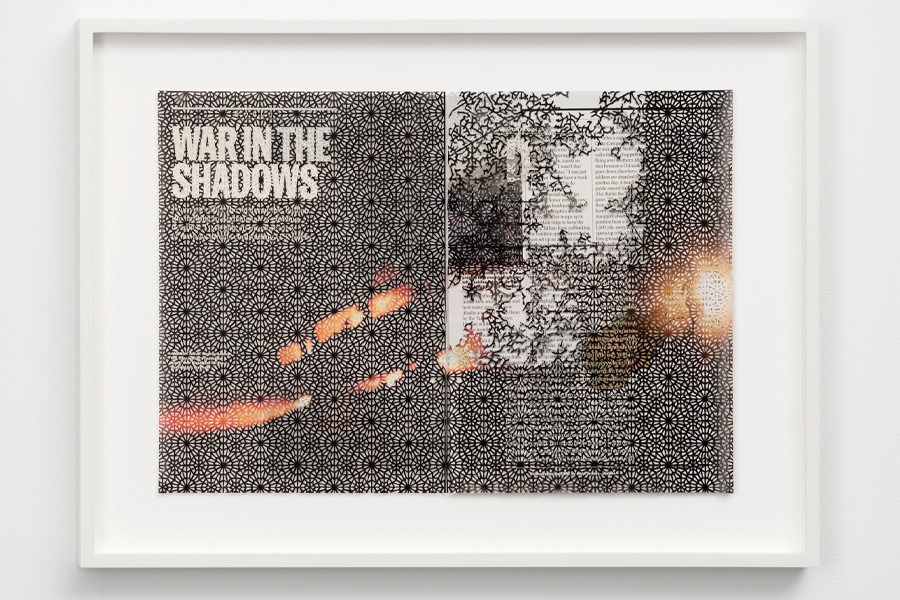
Samira Yamin, (Geometries) Fire VII, 2017, hand-cut TIME Magazine pages. 15 3/8" x 10 3/8". Courtesy of the artist.
“As an artist, I've been around long enough to become a colleague to my mentors,” Yamin said. “As a teacher, I see myself raising a generation of students who I will be in conversation with — who will be my future colleagues.”
Yamin teaches medium-agnostic courses at the ArtCenter College of Design, where her approach is shaped by her UC Irvine experience.
“My peers from UC Irvine continue to be the most generative and supportive of my career on a day-to-day basis,” Yamin said. “When I teach, I think about creating class cohesion, so that moving forward, they’ll similarly have lasting relationships to rely on.”
To learn more about the Department of Art, visit arts.uci.edu/art. To learn more about the Guggenheim Fellowship, visit gf.org.
Please visit our secure direct giving page and make a gift to support UCI Arts today!