The Symphony’s New Movement
 Share
Share

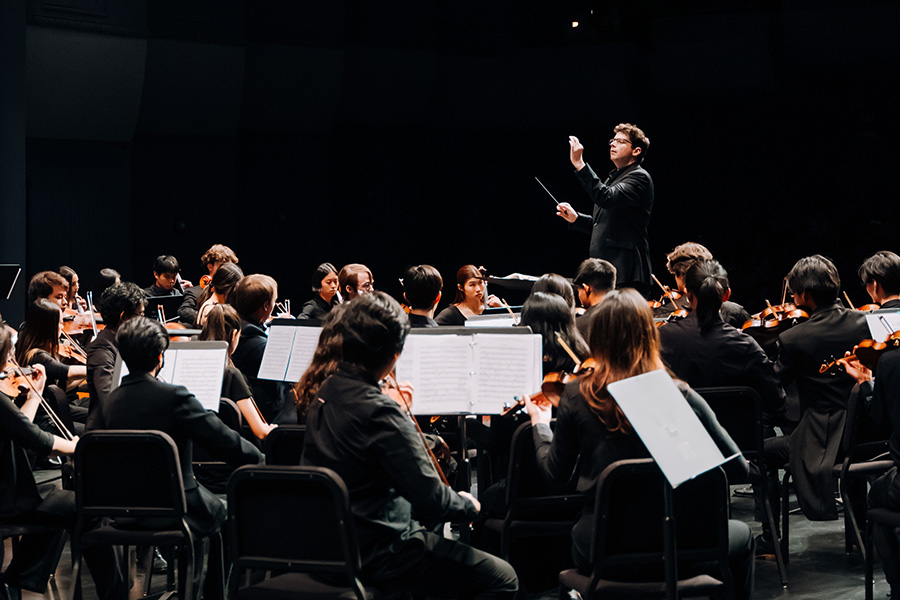
Geoffrey Pope leads the UCI Symphony Orchestra during a spring 2026 performance. Photo by Jasmin Miranda.
Geoffrey Pope conducts a growing sense of community as UC Irvine's director of orchestral studies
By Christine Byrd
Since taking the helm of the UCI Symphony Orchestra, Geoffrey Pope’s motto has been to play more music, by more people, more often.
Variety is a natural inclination for a musician who is as comfortable giving pre-concert talks on classical music for the Los Angeles Philharmonic as he is conducting film scores in a Hollywood recording studio.
Pope was appointed assistant professor of teaching and director of orchestral studies in the Department of Music at UC Irvine Claire Trevor School of the Arts (UCI Arts) in 2025 after serving two years in an interim role. He’s already made a major impact, creating UC Irvine’s new Symphony Express series, launching a Side-by-Side rehearsal series with the Pacific Symphony, and keeping the ensemble thriving amid a challenging time for arts funding.
“Geoffrey's repertoire choices for the symphony reflect a wonderful commitment to balancing traditional and modern works, and the students have been very enthusiastic about his leadership,” said Michael Dessen, professor and chair of the Department of Music. “In addition to the symphony, he also brings a wide range of teaching expertise in conducting, composition, orchestration and the music industry, and it's been exciting to see the diverse courses that he's developing here in those areas as well.”
Inspiring Sound
At UCI Arts, Pope serves as conductor for the UCI Symphony Orchestra, the UCI Opera and other ensembles that support Department of Dance and Drama performances — bringing with him nearly two decades of professional experience in these capacities. He earned a doctorate of musical arts from UCLA, master’s degrees in composition and conducting from the Eastman School of Music and a bachelor’s in composition and theory from USC.
“My aim is not only to hold students accountable to the music and create an environment where they want to keep pushing themselves, but also help develop them into strong musical thinkers,” said Pope.
With around 70 musicians, the UCI Symphony Orchestra brings together students from across campus. Only half are music majors — and half of those are double majors in music and another field such as pre-med, computer science or criminology. Most of the players auditioning for the symphony have already devoted 10 to 15 years to their instrument, making them strong and passionate musicians. Many are now adding the recently created music minor to their academic program after spending time in the orchestra.
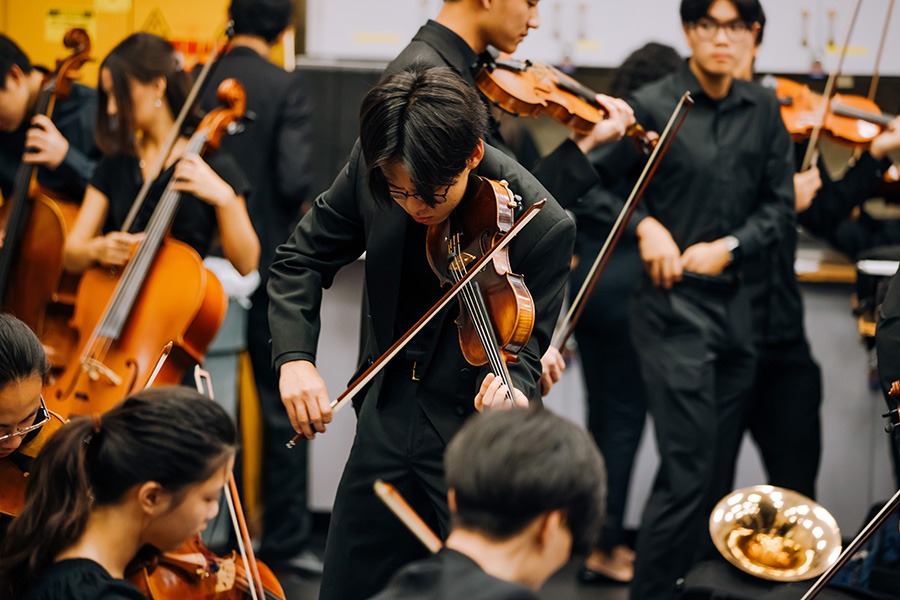
UCI Symphony Orchestra students prepare backstage ahead of a spring 2026 performance. Photo by Jasmin Miranda.
“Geoffrey has a wonderful understanding of how to serve all these different students together, presenting them with challenging repertoire while also cultivating a strong sense of community and collaboration within the ensemble,” said Dessen.
To Pope, the musicians’ diversity and musical goals are one of the orchestra’s strengths. “I have no doubt somebody from our program is going to go out and cure Alzheimer's disease or accomplish something equally remarkable,” he shared. “But if they realize that they can have music as a rich part of their life, even when performance is not their primary focus, then I've succeeded.”
For students pursuing professional music careers, the Side-by-Side rehearsal series with the Pacific Symphony helps them connect with Orange County’s classical musicians. And for those pursuing other paths, the opportunity may be a once-in-a-lifetime experience.
Pope added the quarterly Symphony Express series to the schedule to offer students opportunities to experiment with new or lesser-known works, and give first-time audiences a free hour-long concert in the cozy venue of Winifred Smith Hall. Last Halloween, the program featured music by a student composer set to the 1922 silent horror film Nosferatu, which was projected on the screen while the orchestra synchronized with it — a challenge for the players and a delight for the audience.
“The Symphony Express allows us to represent composers from diverse backgrounds, diverse styles, diverse time periods, and also gives students the chance to play in a different setting,” Pope said.
In addition to his duties as maestro, Pope teaches composition, orchestration and conducting — courses that he says lay the foundation for the intersection of performance and scholarship that defines the Claire Trevor School of the Arts.
“To my conducting students, I emphasize the connection of the tip of the stick to the sound production — almost like a bow contacting the string or putting your finger in an electrical outlet. There's an energy there, and you’re extruding sound,” Pope said. “But you must also be able to understand this as a composer or orchestrator. It changes the way you work.”
Assistant Professor of Teaching and Director of Orchestral Studies
Classical to Contemporary
Pope extends his teaching to concertgoers, too, putting a great deal of thought into the unique perspectives and insights he can bring to his pre-concert talks. It’s not only UC Irvine audiences who benefit from his expertise. Pope is an active faculty member for Upbeat Live, the Los Angeles Philharmonic’s pre-concert lecture series and podcast, where he has taken audiences on deep dives into works of composers such as Richard Wagner and Arnold Schoenberg.
Pope’s expertise is not limited to classical music, either. He works in the music industry, serving as an orchestrator, conductor and forensic musicologist for television, film and video games, on projects ranging from the Academy Award-winning Sinners to the massively popular League of Legends. Two series for which he conducted sessions last summer in Budapest — Palm Royale (Apple TV) and Game of Thrones: Knight of the Seven Kingdoms (HBO) — are currently Emmy® finalists for Best Score.
“I love working in the studio as a session conductor because I get to engage very succinctly with musicians of the highest caliber,” he said. “We have a very clear objective: make this sound perfect within a very limited amount of time. We’re all looking at the music for the first time, which is thrilling.”
As a forensic musicologist, Pope also works behind the scenes with composers and artists to avoid lawsuits and defend against copyright infringement, following in the footsteps of his mentor Judith Finell, the musicologist who helped Marvin Gaye’s family win a landmark copyright infringement lawsuit over Robin Thicke and Pharrell Williams’ song, “Blurred Lines.”
His ongoing work in the industry provides unique opportunities for UC Irvine music students, as well.
“Geoffrey brings regional as well as international connections that will help connect students with the professional field,” said Dessen. “He's quickly proven himself to be a very strong and committed mentor to students, giving them close guidance and helping them succeed in making the transition to graduate programs and important career opportunities.”
Pope’s passion for music in film and TV overlaps with his scholarly work, which focuses on diegetic music, or music built into a scene that characters are hearing, such as a radio or someone playing the piano in a bar. That music often has fascinating interactions with what the orchestra is doing at the same time, whether in opera or film.
This pairing will come to life at the fall UCI Symphony concert in the Irvine Barclay Theatre, in which students will perform suites of Bernard Herrmann’s scores from cinematic masterpieces Vertigo and Taxi Driver, as well as the "Prelude and Liebestod" from Wagner’s opera Tristan and Isolde — with Pope drawing a musical throughline from the mid-nineteenth century through the twentieth.
“As a conductor, you must have something to say through the musical choices you make, and be able to articulate it through the musicians to the audience,” said Pope. “In that sense, a conductor is always an educator.”
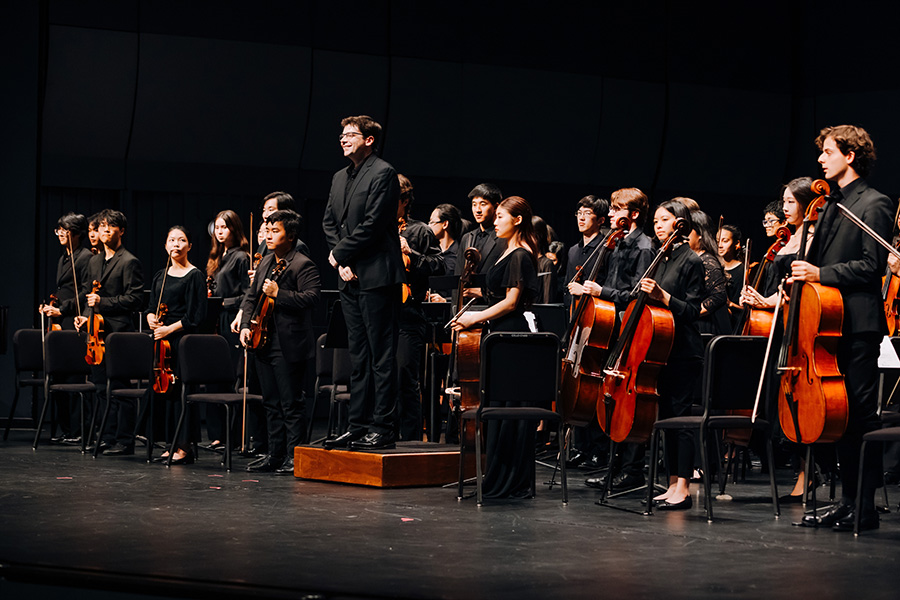
Geoffrey Pope and the UCI Symphony Orchestra take a bow following a spring 2026 performance. Photo by Jasmin Miranda.
To learn more about Geoffrey Pope, visit his Department of Music bio page here. To learn more about upcoming orchestra performances in the music department, visit arts.uci.edu/events.