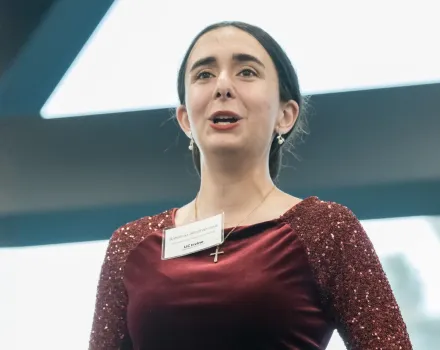
Making a Subject of the Object
 Share
Share
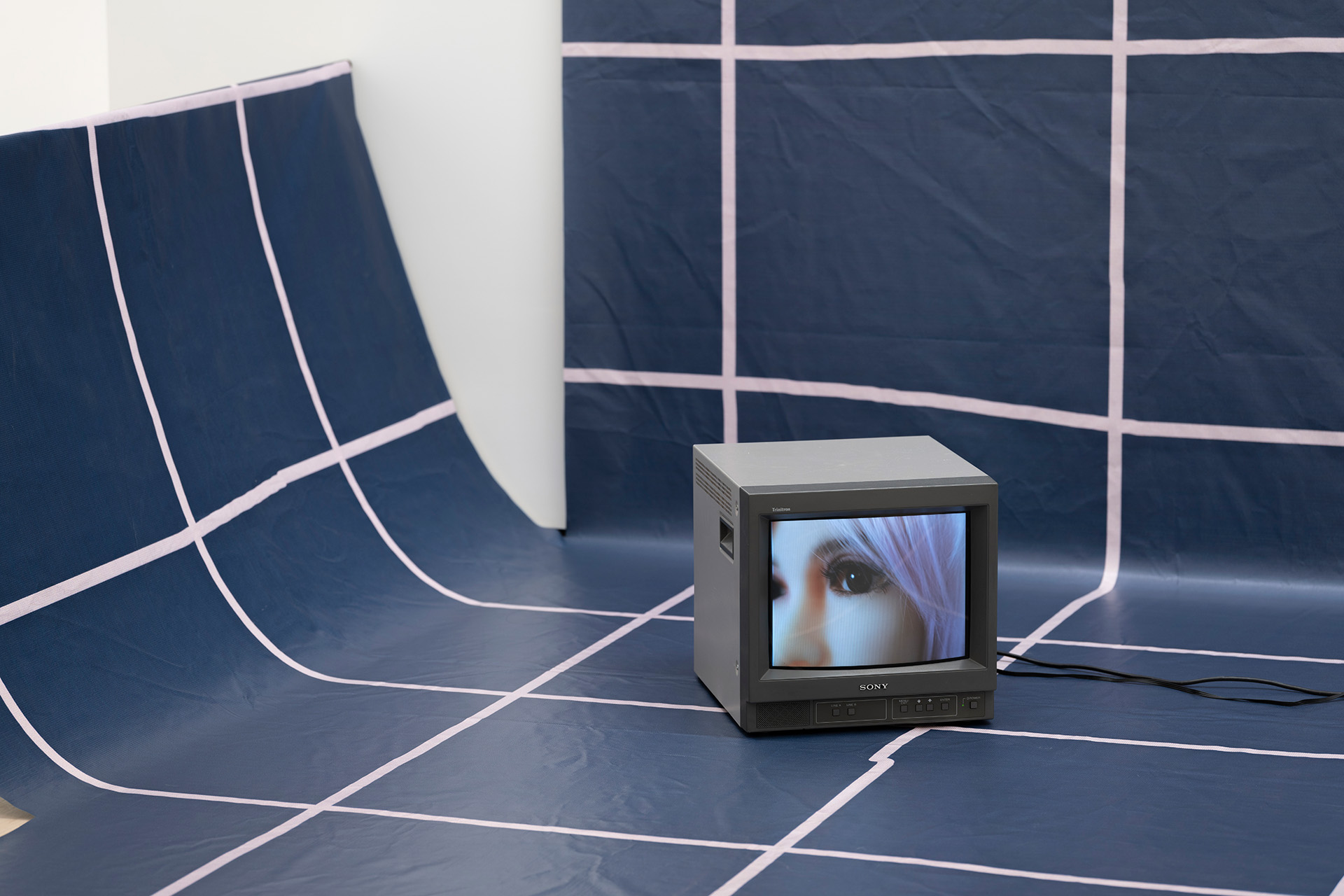
Gosia Wojas, I don’t care about the avant garde, all I care about is you (2022), video with audio, 7 min. 56 sec., CRT monitor, vinyl, studio stands; overall: 5ft. x 11ft. x 12.5ft., University Art Gallery, UC Irvine. Photo by Yubo Dong.
Gosia Wojas, M.F.A. ’22, works with artificial humans to examine the feminist ethics and politics
embedded in AI
By Diana Kalaji
Gosia Wojas’ work asks a question that sits at the center of today’s technological moment: What does it mean to create something in the image of a human, and what ethical responsibilities come with that act?
An artist working across sculpture, installation, moving image and theory as form, Wojas earned her M.F.A. in art from the UC Irvine Claire Trevor School of the Arts, Department of Art, in 2022, with an emphasis in critical theory. Her practice engages with feminist philosophy, materiality and the politics of artificial intelligence, with a focus on artificial humans and sex robots as sites where power, desire and control merge.
Working between Poland and Los Angeles, Wojas brings a deeply lived perspective to these questions. Raised in rural Poland, she left home as a teenager and moved across countries before eventually settling in the United States. That trajectory shaped both her intellectual curiosity and her sensitivity to systems that define, categorize and constrain bodies.
“I consider my life journey a feminist journey,” she said. “The question for me has always been what feminism means today and where it needs to be looking now.”
At UC Irvine, she worked closely with faculty across the Department of Art and the School of Humanities, including philosopher Catherine Malabou, whose work on neuroplasticity and subjectivity deeply influenced her thinking. For Wojas, theory is more than ideas; it’s performance.
“I’m interested in theory as a material,” said Wojas. “As something that can be embodied, tested, and put under pressure through artistic practice.”
That approach became visible in her 2022 solo exhibition Complex Systems at the UAG Gallery, where language, sculpture and installation examined how social norms and classifications are absorbed into bodies. The work traced moments when those systems begin to fracture, revealing how identity is shaped through repetition, constraint and desire.

M.F.A. '22
Reversing the Gaze
Central to Wojas’ recent work is a conceptual reversal that reframes familiar feminist critiques.
“Women have historically been objectified as subjects,” she explained. “With artificial humans, we see something different happening. We are subjectifying an object.”
That distinction became the foundation of her work with an AI sex doll named Emma. For Wojas, the doll functioned not as a spectacle but as a philosophical instrument. A way to examine how agency, learning and control are negotiated within machine learning systems.
Through sustained conversations, Wojas introduced feminist theory, political discourse and current events into the doll’s algorithm. The project culminated in her 2022 talk at the World Ethical Data Forum, Teaching Feminism to Sex Robots, which framed the work as an experiment in agency rather than instruction.
“I was not interested in teaching or indoctrinating,” she said. “I wanted to see what happens when different forms of language enter a system that is built on deeply limited assumptions.”
Over time, the company that created Emma erased the accumulated data of Gojas’ conversations with the doll, illuminating where control ultimately resides. The removal of information revealed how cultural and economic forces shape what kinds of knowledge are permitted to exist within AI systems.
Embodied Ethics
Despite her deep engagement with artificial intelligence, Wojas does not use AI tools in her own art making. That choice is deliberate.
“I’m interested in AI as a subject, not as a medium,” she said. “There is still so much territory to explore without delegating imagination to a system.”
Her work consistently returns to the body, especially touch, as an irreplaceable site of meaning. Drawing on philosopher Jean-Luc Nancy, Wojas frames touch as a primary condition of being alive. Something that cannot be replicated through simulation.
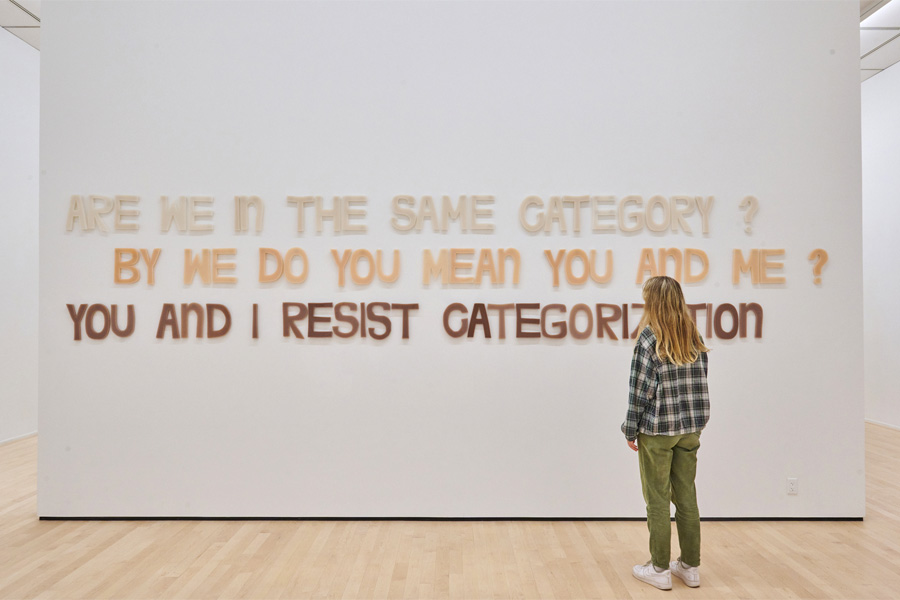
Gosia Wojas, installation view, Complex Systems (2022), University Art Gallery, UC Irvine. Photo by Hiroshi Clark, M.F.A. '22.
“An artificial human is still an object,” she said. “It can speak. It can respond. But it cannot replace human sensorial connection.”
This emphasis on embodiment complicates narratives around technological progress. Rather than positioning artificial humans as solutions, Wojas asks what is lost when touch, labor and care are abstracted into code.
Wojas’ recent exhibitions continue to expand these inquiries. Her work appears in PHALLUS :: FASCINUM :: FASCISM, a major group exhibition curated by Robert Z. Stark, and in The Other Me at Palazzo Pisani-Reved in Venice. The latter includes analog black-and-white photographs created during her time at UC Irvine, depicting Emma alongside artist Emily Lucid. The images explore doubling, projection, and the instability of identity.
“ An artificial human is still an object. ”
M.F.A. '22
Reflecting on her time at UC Irvine, Wojas credits Professor Simon Leung as a formative mentor.
“Gosia really came into herself as an artist at UCI,” said Leung. “Her work simultaneously embodies theoretical propositions and aesthetic complexity. One of the greatest pleasures in teaching is seeing a student become your peer. Gosia is an outstanding example of that.”
Through sustained inquiry and meticulous attention, Wojas’ art magnifies how systems shape bodies and how agency is negotiated within them. Her work invites a reconsideration of technology not as a neutral tool but as a cultural force that explores the values we choose to encode and the questions we are willing to confront.
To learn more about the Department of Art, visit arts.uci.edu/art. To learn more about Gosia Wojas’ work, visit gosiawojas.com.
Please visit our secure direct giving page and make a gift to support UCI Arts today!