Artists to Watch Series: Kurt Kana
 Share
Share
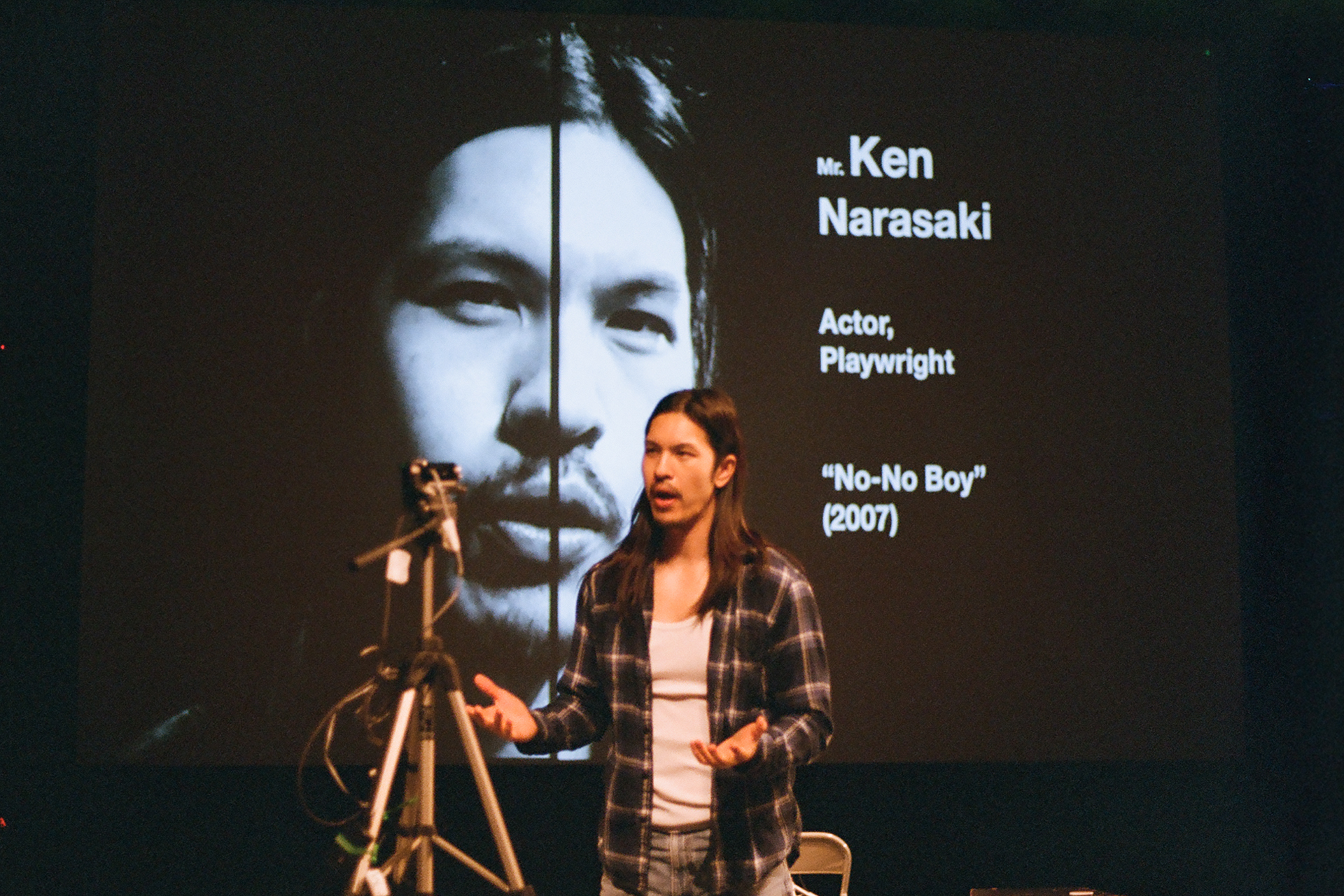
Kurt Kana in rehearsal for No-No Boy, a Solo Show. The projection behind him references Ken Narasaki, the actor and playwright who wrote a stage version of the novel. Photo by Paul Daisuke Goodman.
A Q&A with the Drama M.F.A. candidate ahead of his third solo show
On Saturday, Oct. 10, 2026, Kurt Kana performs No-No Boy, a Solo Show at the Experimental Media Performance Lab (xMPL). The one-act, written and directed by Scott Keiji Takeda, revisits John Okada's 1957 novel No-No Boy with live film elements. A preview and open dress rehearsal begins at 4 p.m., followed by the performance at 8 p.m. Admission is free with registration.
Kana is the first artist featured in Artists to Watch, a new UCI Arts series that follows one artist from each of the school's departments as they bring new work to audiences across disciplines.
A third-year M.F.A. candidate in the Department of Drama at UC Irvine Claire Trevor School of the Arts, Kana is an actor, opera singer and playwright. Born and raised in Los Angeles, of Japanese and Filipino descent, Kana trained at The Juilliard School and Manhattan School of Music and is a graduate of Columbia University. His first solo show, L'OPERA!, premiered off-Broadway at Pan Asian Repertory and was presented by the Japanese American National Museum's Democracy Center. His stage credits include East West Players, Edinburgh Fringe and NCPA-Beijing. His film and television credits include Grey's Anatomy, The Lincoln Lawyer, Bosch: Legacy, A Life in Pieces: The Diary and Letters of Stanley Hayami and No No Girl.
The production is also the Medici Circle project of production stage manager Lala Ukita ’28, who chose No-No Boy, a Solo Show for both its form and its subject. Medici is committed to supporting creative research at UCI Arts.
"I was drawn to how unique the production is with its use of live camera feedback, and to how it highlights the psychological impact of incarceration that the Japanese American community faced during World War II," shared Ukita. "Working with Kurt throughout the production process has truly been a blessing. He has supported the creative and production team with his insights, artistic vision and kindness to elevate this story by John Okada in such a fun but impactful way."
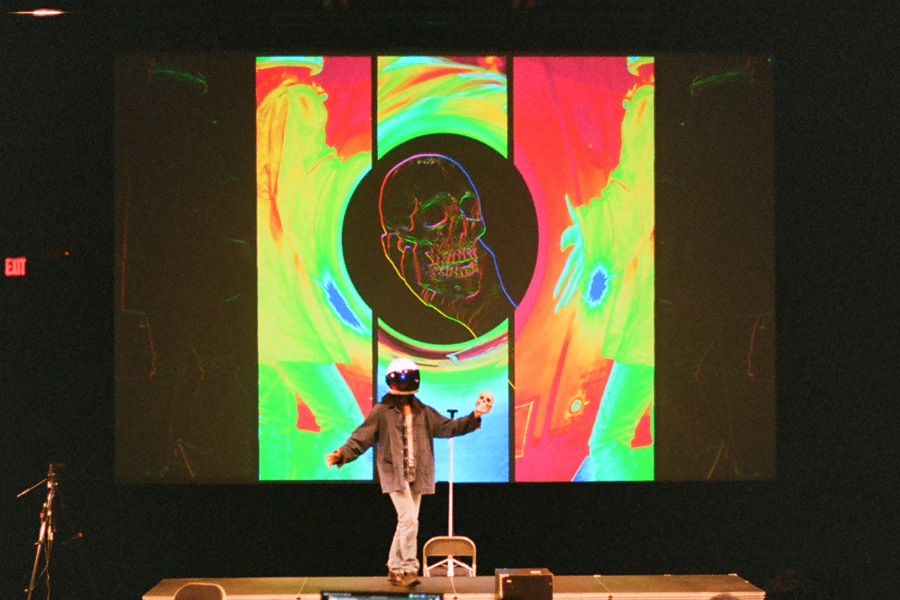
Kurt Kana rehearses a scene from No-No Boy, a Solo Show, that pairs live performance with film elements. Photo by Paul Daisuke Goodman.
Keep Reading for a Lightning Round section inspired by the Pivot Questionnaire
Question (Q): How would you describe your artistic practice and pedagogy? And what kinds of work are you drawn to?
Kurt Kana (KK): The number one thing in my pedagogy is freedom, literally, figuratively and physically. What I'm trying to give my students most is the freedom to physically express themselves in ways they may never have considered, or have limited themselves from. You could almost call it a maximalist aesthetic for training, but it is completely based in the body. I don't base anything I do on your past traumas. I think that's an outdated way of teaching acting. We can access a lot through physical gestures, body tensions and the release of those tensions, and I've found that valuable, safe and accessible for actors. We don't need a world where people are exploited to have great performances.
There's actually science around it. When you hold a gesture, you end up feeling an emotion. If you pull your eyebrows together, bare your teeth and widen your eyes, eventually you will feel aggression in your body, and you didn't have to do much. You can use that to find the feeling and return to it authentically and immediately, without having to imagine doing something violent. Some people might call it a cheat code. But if you haven't explored where your body is emotionally, you're just using your brain. I'm trying to get people to use their brain less and their body more. The less I think, the more I can feel with my body what my scene partner is feeling. Which is also why I love teaching Meisner Technique alongside this kind of physical training.
As for the work I'm drawn to, fun is the underline for me. I need a sense of play. I like being tricked. Make me laugh and then make me cry is my favorite delivery system.
Q: You went to graduate school at Juilliard and are now in your third year in UC Irvine's M.F.A. program. What drew you to pivot from the traditional conservatory path to an arts school that is also part of a top-10 public research university?
KK: Going to a public institution was a huge part of my choice to get an M.F.A. I only wanted to go to a place where I could do Asian American work, ideally by a living Asian American playwright. When I was thinking about grad school, UC Irvine was the only school I saw that had programmed an Asian American playwright in its main stage season. That was Prince Gomolvilas, who is also a friend and teacher of mine. They did The Brothers Paranormal, which is such a great play. Asian American plays are part of the American canon, and there are a lot of elite schools that have not programmed one in a decade.
UC Irvine also uniquely uses its undergraduates in casting, which means you can cast a family or multiple siblings, and you can be cast with people in other classes. I was concerned about going to a school where I would potentially be the only Asian person in the class, or one of two or three. That does not equal an Asian American play. You're usually playing someone who is non-racialized, or a role where your race wasn't considered. Not to say that hasn't happened here, but the school is so aware of its Asian American population, which is 35% of the student body and a huge part of the county.
Above all, activism brought me here. I didn't want to get higher training in an environment that didn't recognize my community as human beings.
Q: Share about your upcoming project, No-No Boy, a Solo Show. What drew you and your collaborators to the work, and what kind of research went into it?
KK: The real genesis of the project is that Scott Keiji Takeda and I have been friends for a long time. There aren't many Japanese American men who sing, full stop. So we naturally found each other. We worked together once on a workshop of a Min Kahng musical with Artists at Play before the pandemic, and again at East West Players in Pacific Overtures. But we wanted to work on something where he was directing and I was in the show, because it has been his lifelong ambition to direct. I was trying to find a way to realize his dream while thinking about the next play I was going to perform.
No-No Boy was published in 1957. It's about a draft resister during the incarceration of Japanese Americans, which was looked down upon in his time. Today we uplift draft resisters and see them as heroes. Then, he was seen as an enemy of the Japanese American people, who were trying to assimilate and look like patriotic citizens while being held in concentration camps. "No-No" refers to a form they were all required to fill out. It declared allegiance to America and agreement to serve on combat duty, and it also declared they were no longer allegiant to the emperor. People had trouble with it because they had never been allegiant to the emperor, so it seemed like a trick question. A lot of people were defiant and answered questions 27 and 28 with "no, no." John Okada wrote the book at a time when No-No Boys were still pariahs in their community, so when it was published, nobody wanted to read it.
We initially thought this would be a true solo show, something like Gatz, Elevator Repair Service's word-for-word staging of The Great Gatsby. Then we ran into interesting obstacles with characters and concepts in the book, and we realized the conversations coming up were really the juice of what we could offer in revisiting it. Paul Daisuke Goodman, who made a feature film called No No Girl, did a lot of research on the novel for that film, and we have a lot of live film elements, which is why we wanted him on the project. You'll recognize the book, but you'll see a different perspective.
Q: This is your third solo show. What draws you to this form, and why does it matter?
KK: I'm challenged by the solo show because economics loves a BIPOC solo show. Predominantly white theater institutions love a BIPOC solo show. Why? Because it's cheap. A cheap show fulfills two things for them. They check off BIPOC, and they check off saved money.
There is certainly a love for the format. I love solo shows, and the genre has given me many things. There is also an intense concern. Why are we constantly doing solo shows? Sometimes it feels like an excuse to not exhibit American diversity. It's a choice, and I think a lot of theaters, and people in general, choose not to.
Q: What do you hope audiences take away from the production?
KK: I hope they walk away with knowledge of No-No Boys and a resonance with the events of today. History is unfortunately repetitive, and we don't hear the lessons. Beyond seeing that resonance, I hope they feel they have an actionable step to take. The play offers many possible solutions, and many flawed ones. We do not tell you the answer for how to fix everything. I hope you walk away entertained by the solutions, see the merit in each of them, and potentially try one or more in your own practice.
Q: The performance takes place in the xMPL, known as the UCI Arts research laboratory. What made you choose to work in that space, and what has it been like?
KK: It's a beautiful space, and this is my third time working in it. I did two Annie Loui shows there, La Belle et la Bête and The Green Knight, where I was seven feet tall with an ax. So I'm familiar with the space and the tech that's available in it. We're so grateful to xMPL associate production designer, Micah Sechler, for being so hospitable. He was a hero and a fighter for us. Eli Simon and Annie Loui have been huge advocates for this project and have really made it happen. I'm so grateful to them and to the xMPL committee.
Q: It takes a village. Who and what programs have supported No-No Boy, a Solo Show?
KK: Eli Simon is the faculty mentor for Lala's Medici Circle scholarship and was the initial catalyst for this project. Annie Loui is our faculty advisor, the first to recommend applying for the xMPL space, and has provided us with generous notes. The show is part of the Drama Emergent Series, which means it's a student-initiated project that the Department of Drama is elevating for its artistic merit, and we are grateful to Chair Joel Veenstra for his support.
East West Players very generously gave us rehearsal space, as well as Josh Reynolds and Ben Slavens. Chris Tashima and Cedar Grove Productions are providing crucial parts of the set. And a big thank-you to Ken Narasaki, who wrote a stage version of No-No Boy, was the first person to hear the idea, and gave us his complete blessing. And we’d especially like to thank Pamela Marsden for her tireless work on this project and so many others.
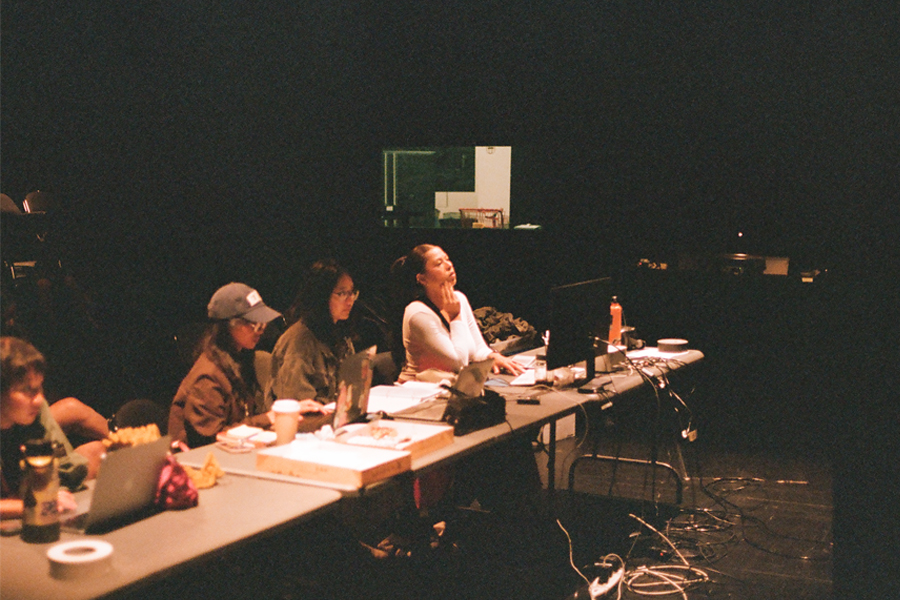
The creative and production team of No-No Boy, a Solo Show, at work during a rehearsal. Photo by Paul Daisuke Goodman.
Lightning Round
Ten questions inspired by Inside the Actors Studio and the Pivot questionnaire.
Q: What is your favorite word?
KK: Freedom.
Q: What is your least favorite word?
KK: Headache.
Q: What excites you creatively, spiritually or emotionally?
KK: Some of the best acting I've seen has happened in a classroom or off a stage, in a small moment. There's so much great work happening that isn't seen in a traditional theater space. It excites me when I walk in on a performance that money couldn't buy. That could be my students, my peers or somebody who doesn't even realize how good they are.
Q: What bothers you?
KK: Racism.
Q: What is your favorite line in a film, TV show or play?
KK: Right now it's a line from Continuity, the play we're about to do at UCI Arts, where my character says something like “Yes, I mansplain, I man-sit, I man-eat, I man-drink.” I'm playing a very fun character, and I think that line is very funny. It should not be my answer right now, but it is.
Q: What sound or noise do you love?
KK: Laughter.
Q: What sound or noise do you hate?
KK: A high-pitched, sustained ringing. Dog-whistle frequencies.
Q: What profession other than your own would you like to attempt?
KK: A train conductor. I love trains. I love the idea of just traveling on a train.
Q: What profession would you not like to do?
KK: Stage management. I've had a lot of amazing stage managers and assistant stage managers and could not be more grateful for them. Shoutout to Sammie Moore and Lala Ukita. I could never do their job.
Q: If you could do anything for the rest of your life, what would it be?
KK: Act.
This event is made possible with the generous support of Medici Circle Patron Valerie Glass and the UC Irvine Drama Emergent Series.
Special thanks to Medici Circle faculty mentor Eli Simon and faculty mentor Annie Loui.
For free registration and more information on No-No Boy, a Solo Show, visit here.