Complexity in Focus
 Share
Share
Getty and the Beall Center for Art + Technology highlight the complexity of our modern challenges
By Christine Byrd
If we learn anything from living through this era of “unprecedented” events, it might be to expect the unexpected. Weather affects the supply chain, health impacts education, geopolitics spill over into our interpersonal relationships.
Our messy, complicated reality is the subject of Future Tense: Art, Complexity, and Uncertainty at the Beall Center for Art + Technology this fall. Arguably the most ambitious exhibition in the Beall Center’s nearly 25-year history, Future Tense was developed with support from the Getty’s landmark Pacific Standard Time arts initiative, PST ART: Art & Science Collide. Featuring 16 artists across two gallery spaces, the exhibition highlights the intersection of arts and science featuring both existing artworks and new pieces created through collaborations funded by the Beall’s Black Box Projects residency program.
“ It’s not just about artists making art informed by science, it’s real science with real art. ”
“We find ourselves today amidst one of the most significant scientific revolutions in human history, necessitating a shift in our worldview,” writes David Familian, artistic director of the Beall Center and the exhibition’s curator, in an essay. “Traditional approaches of breaking problems into parts prove insufficient for comprehending complex systems.”
The exhibition is the culmination of Familian’s decades-long fascination with complexity studies and cybernetics and, he hopes, the beginning of further conversations. The artworks, many of which feature interactive elements, are powered by algorithms, sensors, artificial intelligence and robotics to underscore the unfathomable complexity of our world.
“It’s not just about artists making art informed by science, it’s real science with real art,” said Familian. “The dialogue between the art and the science is serious, rigorous.”
Upon entering the University Art Gallery, guests will encounter works from Carolina Caycedo and David de Rozas, Fernando Palma Rodríguez and Ralf Baecker that evoke chaotic, frenetic energy. Then, moving through the exhibition and awakening sensors that introduce sounds and movements into the space, visitors are guided through the complexity intrinsic to our natural environment, our politics and history, and even our relationships.

Image: Laura Splan, Studio production for Baroque Bodies (Sway). Commissioned by the UC Irvine Beall Center for Art + Technology’s Black Box Projects residency program, with support from Getty. Photo: Zeke Kimball. Courtesy of the artist.
On Closer Inspection
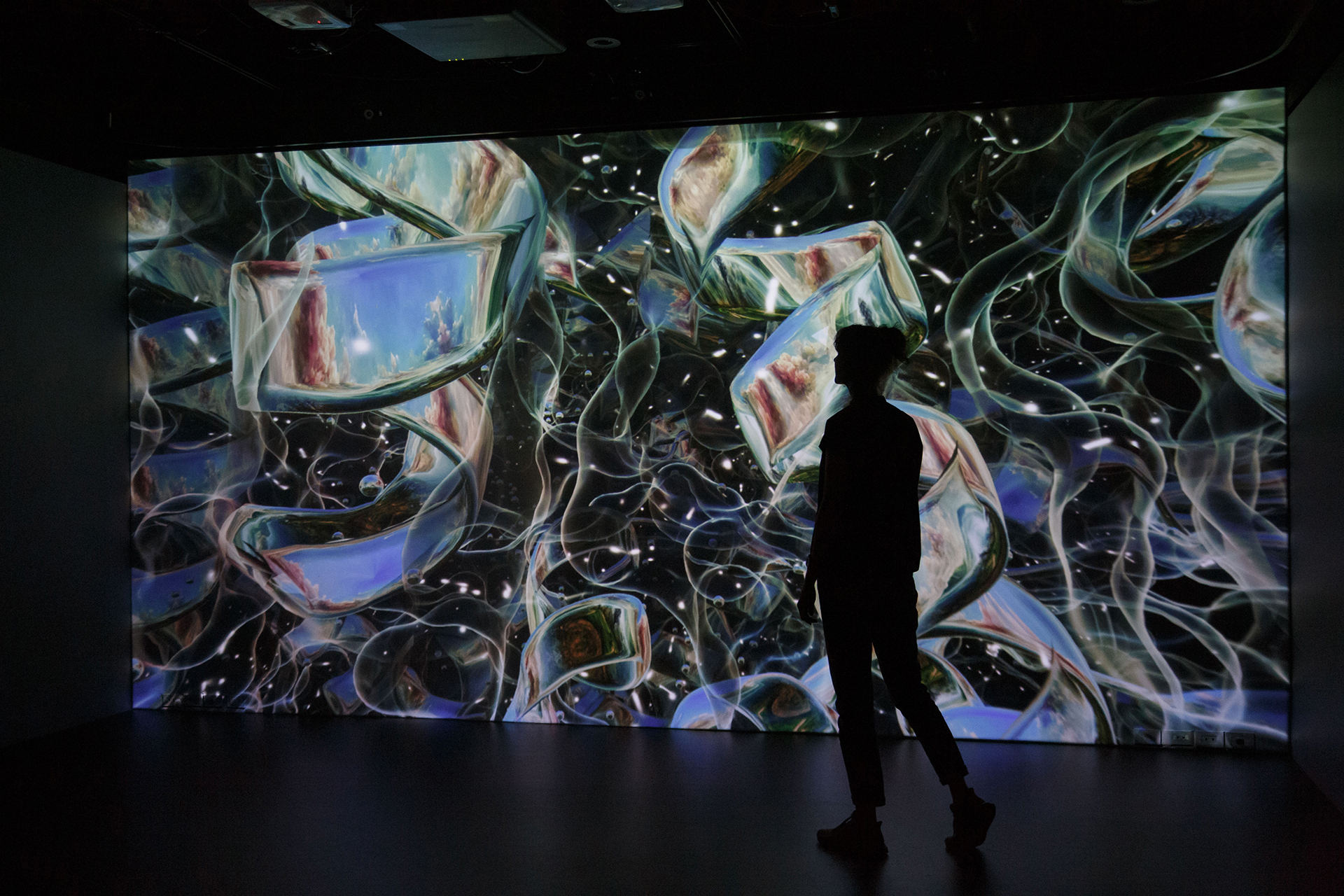
Baroque Bodies (Sway) by Laura Splan ’95, plays with the complexity of epigenetics. She developed the project in collaboration with several scientists including Hannah Lui Park, Ph.D., UC Irvine associate professor in residence of epidemiology and pathology. Epigenetics complicates a basic truth that many of us grew up learning in science class: that our DNA is our destiny. In fact, the environment can change the expression of genes, so that anything from the air we breathe to the stress we experienced in the womb can influence how DNA plays out.
Splan explores this with a large 3-D video projection of an animated scientific model of a nucleosome — a molecular structure involved in epigenetic expression — that she ensconces in sci-fi elements. The surfaces of the structures reflect AI-generated images of environments that might influence gene expression: idyllic scenes that might be kept lush with pesticides. Splan generated the landscapes by feeding the AI excerpts from Park’s peer-reviewed research papers.
“Hopefully you’re compelled to approach it and inspect it more closely,” said Splan. “A lot of my work is about the embodied experience of inspecting detail — like squinting or touching.”
As you approach Baroque Bodies (Sway), sounds created from a scientific dataset start to play, and the 3-D nucleosome zooms in closer, until someone else approaches and takes control. Multiple visitors in the area create a sort of tug-of-war with the image gyrating in and out as they compete — perhaps unwittingly — for control. Splan used the Beall Center’s Black Box residency to explore embodiment further by adding these interactive elements to her previous Baroque Bodies works.
“There are a lot of layers to the piece visually, conceptually, technically that have been really fun to complicate through the concept of the exhibition itself,” said Splan. “The work was already very much situated in complexity and uncertainty around environmental influences on gene expression and how those can be inherited, so this project provided an opportunity to deepen that.”
This work is one of five new pieces in the show that are the result of the Beall Center’s Black Box residency, but Splan’s interest in arts and science dates back to her experience as an undergraduate at UC Irvine. Though she originally planned to major in biological sciences and pursue veterinary medicine, her exposure to courses in humanities topics like bioethics, social politics and women’s studies led her to art, where she could explore broader cultural questions. Splan, who went on to earn an M.F.A. from Mills College, said the most important aspect of her arts education at UC Irvine was its conceptual focus.
“Studio art is about learning how and why to make art no matter what tool you use. What are the ideas you’re trying to express and what’s the best tool to express that idea?” Splan said. “I’m really thankful for that approach and philosophy. I use a lot of very sophisticated technology in my work, but my process is about finding the narrative implications of the technology itself.”
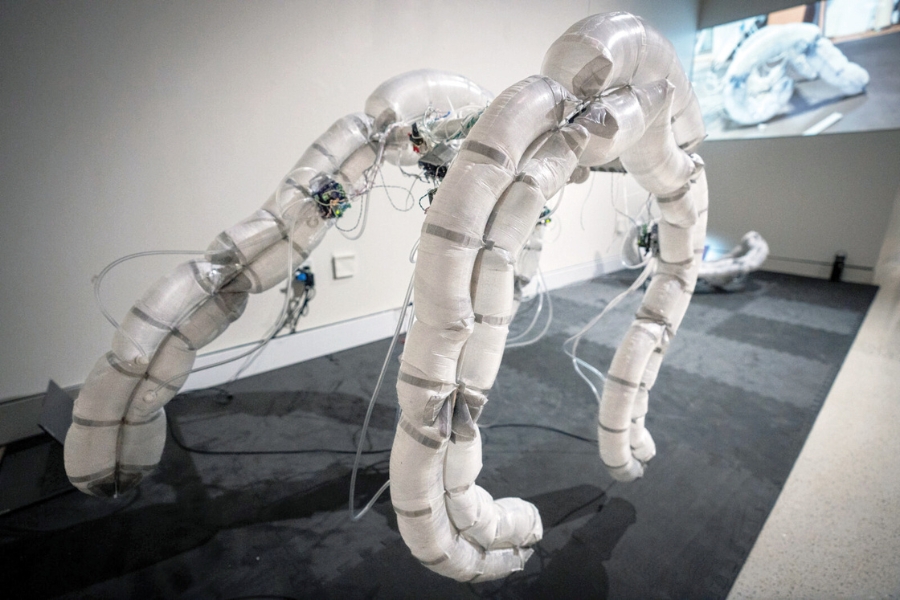
Image: Chico MacMurtrie. Dual Pneuma (prototype II), 2024. High-tensile Tedlar fabric, pneumatic technology, electronics, software. © Chico MacMurtrie/ARW. Photo: Hector Bracho.
Robotic Breath and Balance
For the last decade, Chico MacMurtrie has been creating large-scale inflatable robots. Softer and more organic than a stereotypical droid, MacMurtrie’s Dual Pneuma will engage with visitors at Future Tense. Its four limbs made of high-tensile fabric inflate, flex and move resembling a cross between a human and an animal. The sounds of whirring air and clicking valves as its muscles move, serve as a gentle reminder that its name derives from the Greek word for "breath."
MacMurtrie collaborated with a number of scientists and artists including, through the Beall Center’s Black Box residency, engineers from UC San Diego and artists from UC Irvine and New York University.
Through the creative process, MacMurtrie became interested in memorializing these soft machines, which, like us, have a finite lifespan. So he turned to ancient mold-making techniques to create casts of the inflatables in ceramic, and carved Mesoamerican-inspired designs into them. Then, he programmed the sculptures to emit beautiful sounds derived from flutes of pre-Columbian cultures, which start playing when visitors walk nearby.
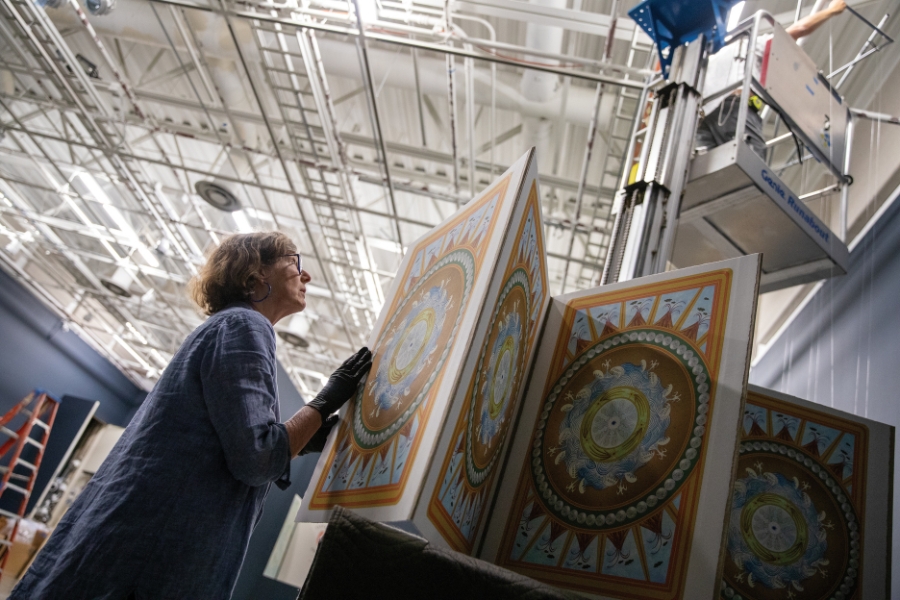
Image: Artist Gail Wight installs Ostracod Rising, an art installation developed in collaboration with a group of artists and scientists through the Beall Center Black Box Residency Project. Photo: Emily Zheng.
“The inflatables have given birth to the ceramics, yet they appear almost like fossils, or distant relatives,” said MacMurtrie. “It’s a complex, contrapuntal relationship, in a sense.”
“ This way of looking at the world is incredibly important — our survival is at stake. ”
Familian hopes that Future Tense leaves visitors not only with a greater appreciation for the complexity of our current time, but with an understanding of the kinds of collaboration across disciplines and fields of scientific study that will be required to navigate an uncertain future.
“This way of looking at the world is incredibly important — our survival is at stake. If we don’t solve problems like climate change, we won’t survive,” he said. “My hope is that this show starts a dialogue.”
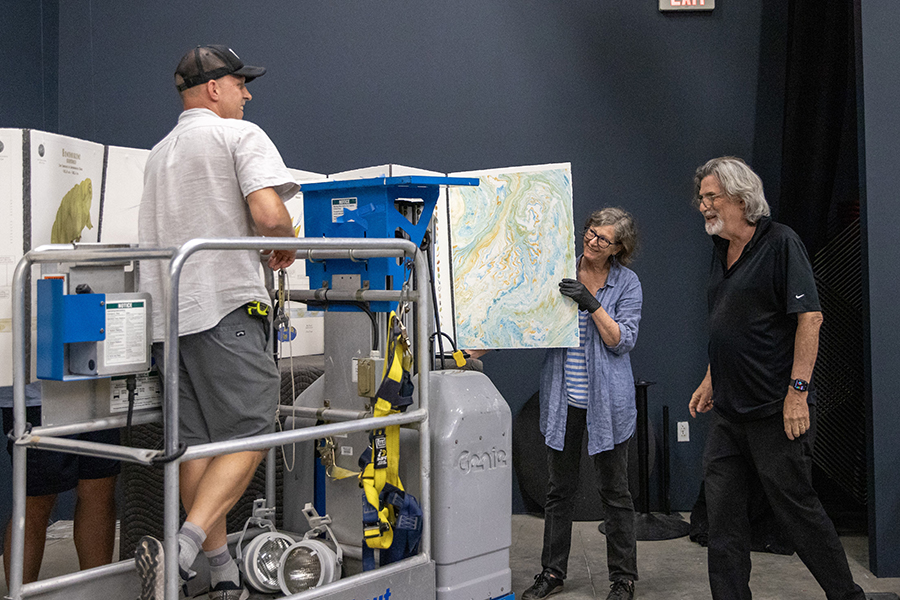
Image: (left to right) Preparator Justin Lowman, artist Gail Wight and curator David Familian work on the installation for Future Tense at the Beall Center for Art + Technology. Photo: Emily Zheng.
The exhibition Future Tense: Art, Complexity, and Uncertainty, in partnership with the 2024 Getty PST ART: Art & Science Collide, will be on view Aug. 24-Dec. 14, 2024. The Beall Center is free admission and open to the public during the academic year on Tuesday-Saturday from noon-6 p.m. Visit beallcenter.uci.edu. for more information on programming.
Please visit our secure direct giving page and make a gift to support CTSA today!